
Employment
for Deaf Signers in Europe
Jemina Napier,1 Audrey
Cameron1, Lorraine Leeson2, Christian
Rathmann3, Chris Peters3, Haaris
Sheikh4, John Bosco Conama2, and Rachel
Moiselle2
Research conducted by
The Centre for Translation
& Interpreting Studies in Scotland, Heriot-Watt University1
The Centre for Deaf
Studies, Trinity College Dublin2
Department for Deaf Studies
and Sign Language Interpreting, Humboldt-Universität zu Berlin3
Interesource Group
(Ireland) Limited, Ireland4
ISSN 2009-1680
First published in January
2020
 This publication has been possible through the financial support of the
European Commission under the Erasmus+ Programme. All project content, analysis
and commentary, reflects the views of the author(s) and the coordinator. The
European Commission is not responsible for any use which may be made from the
information contained in any of the DESIGNS publications/products.
This publication has been possible through the financial support of the
European Commission under the Erasmus+ Programme. All project content, analysis
and commentary, reflects the views of the author(s) and the coordinator. The
European Commission is not responsible for any use which may be made from the
information contained in any of the DESIGNS publications/products.
Executive Summary
The Erasmus+ funded DESIGNS project team took an action research
approach to examining the situation of deaf graduates who are sign language
users, employers and sign language interpreters to inform our end-goal, the
production of research-informed training materials for these stakeholder groups
within the national contexts of Ireland, Germany and
the UK. The research
team drew upon the quite sparse empirical literature that
exists on deaf signers in employment, cross-referencing that against policy
data and census figures (Chapter 2).
We find a trend of increased
participation in higher education as a result of increased provision of sign
language interpreters in this sphere (typically facilitated through disability
legislation). As a result, more deaf signers are achieving higher-level
qualifications and seek to enter the workforce in a range of professional roles. In turn, there is a commensurate increasing
demand for interpreters to facilitate interactions in the workplace between
deaf signers and their non-deaf, non-signing (hearing) counterparts.
We note that deaf signers in the workplace generally seek provision of sign language interpreters as a preferred adjustment and that State support for such provision is highly variable. We report that in the UK, funding for British Sign Language (BSL) interpreters is mostly funded through the Government’s Access to Work Scheme, while in Ireland, there is minimal funding available to cover the costs of interpreters for job interviews and initial work-start training, but not as an on-going accommodation in the workplace. In Germany, German Sign Language (DGS) interpreting services and deaf-related equipment costs are mostly funded through the Government’s Integrationsamt. There is some further funding provided for employees with disabilities (including Deaf employees) via Agentur für Arbeit, the government agency, which provides deaf signers with an ever-reducing allocation of funding for a period of 4 years, at which time the employer is expected to take on full responsibility for salary costs.
In analysing our data, we identified a series of five gaps, which were prevalent in all three countries and these hold across all three stakeholder groups (deaf people, interpreters and employers). These are: (i) a knowledge gap, (ii) an organisational culture gap, (iii) an experience gap, (iv) a feedback gap, and (iv) a systems gap. We make a series of recommendations around bridging these gaps in Chapter 5.
Table of Contents
1.2 Deaf signers
and employment
1.3 Using an
action research approach
1.3.1 Identifying an issue or problem to study
1.3.2 Gathering and reviewing related information
1.3.3 Developing a plan of action
3.1 A note on
doing research with signing deaf communities
3.3.1 Participants and recruitment
3.4 Interviews
and focus groups
4.1 A snapshot of
deaf access to employment in Europe
4.1.1 Are interpreters provided for job interviews?
4.1.2 Is sign language interpreting available in the
workplace?.
4.1.3 Are sufficient accommodations provided to meet deaf
signers needs?
4.1.4 How do national associations support deaf signers in
employment?.
4.2 Deaf signers’ perspectives
4.2.1 Knowledge gap: Education to work transition
4.2.3.1 Interpreter employment status
4.2.3.2 Preparation, feedback and competence
4.2.3.3 Availability of interpreters
4.2.3.4 Role and behaviour of interpreters
4.2.6 ‘Hearing’ work environment
4.3 Sign language
interpreter perspectives
4.4.1 Employment opportunities for deaf people
4.4.2 Advantages and disadvantages of employing deaf people
4.4.3 Diversity and inclusion policies
4.4.4 Dynamics in the workplace
4.4.5 Accommodations for deaf employees: Booking and paying
for interpreters
Chapter 5: Discussion and Conclusion
Bridging the Organisational Culture Gap
Contributors
Project research team
Professor Jemina Napier (Heriot-Watt
University)
Dr Audrey Cameron (Heriot-Watt
University)
Professor Lorraine Leeson (Trinity
College Dublin)
Professor Christian Rathmann (Humboldt-Universität zu Berlin)
Chris Peters (Humboldt-Universität zu Berlin)
Haaris Sheikh (Interesource Group
(Ireland) Limited and Trinity College Dublin)
Dr John Bosco Conama (Trinity College Dublin)
Rachel Moiselle (Trinity College
Dublin)
Research assistants
Lucia Venturi (Trinity College Dublin
and Bridge Interpreting)
Aletta Heldt,
Anna Grimm & Andreas Bittner (Humboldt-Universität zu Berlin)
Partner organisations
The following organisations were
critical partners in facilitating contact with research participants and
generating data:
• Association for Higher Education Access and Disability (Ireland)
• Association of Sign Language Interpreters UK
• European Union of the Deaf
• European Forum of Sign Language Interpreters
• Vercida (UK)
• Integrationsfachdienst Weisensee, Berlin (Germany)
Advisory Board members (UK)
Teri Devine, Action on Hearing Loss
Gail Dixon, Association of Sign
Language Interpreters
Charlene Dolan, British Deaf
Association
Dionne Thomas, Deaf Business Academy
Jason Barnett, Deaf PLUS
Janis McDonald, Deaf Scotland
Alison Bryan, Deaf UK Jobs
Alisoun Probert, Department of Work
and Pensions
Jules Dickinson, independent researcher
and sign language interpreter
Acknowledgements
We would like to thank the following
people who have played a particularly important role in ensuring that the
project was successful. In no particular order:
· Emmy Kauling and Mette Sommer, PhD students at Heriot-Watt University, for their contribution to data collection and subsequent presentations and training.
· David Summersgill, for his support with interviews and English translations of BSL data.
· Philip Gerard, Lisa Roy, Shaurna Dickson and Mark McMillan from Deaf Action in Edinburgh for their support of the project, and for their input to the delivery of the DESIGNS masterclass and provision of the Deaf Action Learning Centre as a venue for training.
· Mark Napier at the Centre for Public Innovation in London for providing a venue for focus groups.
· Robert Adam and Bencie Woll at the Deafness, Cognition and Language research centre at the University of Central London for providing a venue for focus groups and case study filming.
· The Association of Sign Language Interpreters UK and Scottish Association of Sign Language Interpreters for distributing the call for interpreter participants to members.
· Ben Chalcraft, Mitchell Richins and Katring Hutchings at VERCIDA for facilitating contact with employers and Tony Barlow of Deaf2Work for facilitating in the masterclasses
· UK Advisory Group members
· Giles Bowman of ITV SignPost and Heriot-Watt University’s multimedia team for producing case study videos
· Toby Burton, Ben Fletcher, Richard Weinbaum, Jules Dickinson, Jackie Wan, Robert MacIntosh, Annelies Kusters, Gary Quinn, Tasnim Sharif and Joseph Sheridan for contributing towards the case studies.
· Cork Deaf Enterprise (Ireland)
· Sign Language Interpreting Service (SLIS) (Ireland)
· Irish Deaf Society
· Bridge Interpreting Limited (Ireland)
· Council of Irish Sign Language Interpreters (CISLI)
· Chime (Ireland)
· German Sign Language Interpreter Association in Berlin and Brandenburg (BGBB e.V.)
· German Deaf Association (DGB e.V.)
· Deaf Association in Munich and Surroundings (GMU e.V.)
· All of our research participants across Europe and interpreters
· World Federation of the Deaf and World Association of Sign Language Interpreters.
Chapter 1: Introduction
1.1 Introduction
Sociology of work studies have moved away from
analysing professions in terms of what constitutes a profession, and have focused
on the relationship between societal forces and occupational strategies and a
person’s ability to obtain and maintain their professional status and identity
(Klegon, 1978). Studies of disabled employees, however, have found that
regardless of the occupational strategies utilised, they still experience
various social and environmental barriers in the workplace (Barnes &
Mercer, 2005). Even with appropriate qualifications, skill set and experience,
the meaning of work for disabled people is not necessarily the same as for
their non-disabled counterparts. Various national and international legal
instruments identify disabled people as a protected characteristic group, which
should prevent discrimination in the workplace, but disabled employees still
experience stigmatisation due to stereotypical assumptions of others
(Mik-Meyer, 2016). In order to do their job, many disabled people require
adjustments in the workplace, which have to be negotiated on an ad hoc basis
with managers who may have little understanding of what is needed (Foster,
2007). Legislatively, in occupational contexts deaf people are also situated as
disabled employees who require adjustments in the workplace, and for them the
adjustment is typically a sign language interpreter.
1.2 Deaf signers and employment
Although deaf signers are typically considered as being disabled within the social model of disability, deaf people experience different barriers due to language, communication and cultural systems rather than more traditional barriers identified by a social model (e.g., access to buildings) (Thomas, 2002). In fact, it has long been established that deaf people who use sign languages constitute a linguistic and cultural minority group alongside other indigenous and minority language groups, based on their shared experience of using sign language rather than their deafness (Brennan, 1992; Batterbury, Ladd & Gulliver, 2007; De Meulder, Werner & De Weerdt, 2017; Ladd, 2003; Lane, Hoffmeister & Bahan, 1996).
There is a tension, however, between societal perceptions of deaf people as being disabled, and their status as ‘sign language peoples’ (De Meulder, 2015; Napier & Leeson, 2016) as often, legislative instruments frame sign language rights within the context of disability rights (De Meulder, 2015; World Federation of the Deaf, 2018). For example, the United Nations Convention on the Rights of People with Disabilities (2007) mentions the rights of deaf people to access their education in sign language (Murray, De Meulder & le Maire, 2018) and also the right to access professional sign language interpreting services in all areas of life (Stone, 2013). Thus deaf signers’ linguistic status is often regarded as a disability access issue. The World Federation of the Deaf argues that an intersectional stance should be taken with regards to regarding deaf signers as being part of both language and disability minority groups:
“deaf people differ from other
linguistic minorities in one important way – while many users of minority
languages are able to learn and function in majority languages, deaf people are
usually unable to fully access the spoken languages of their surrounding
environment because of their auditory-oral transmission. Therefore, sign
languages are not only culturally important, they can be the sole means of
language development and accessible communication for deaf people.” (World
Federation of the Deaf, 2018, pp.10-11).
For deaf signers in the workplace, the adjustment required is typically provision of a sign language interpreter. In the context of this research report, we focus on the UK, Irish and German contexts. In the UK, funding for BSL interpreters mostly comes through the Government’s Access to Work Scheme (with employers sometimes also expected to make a contribution towards interpreting costs), which was established to support disabled people to obtain and maintain employment (See www.gov.uk/access-to-work). In Ireland there is minimal funding available to cover the costs of interpreters for job interviews and initial work-start training, but not as an on-going accommodation in the workplace; and in Germany, there is Agentur für Arbeit government funding available, whereby deaf signers receive a higher allocation of funding in their first year of work, which is reduced year-on-year for 4 years until the employer is expected to take on full responsibility for salary costs. Due to increased provision of interpreters in higher education (typically facilitated through disability legislation), more deaf signers are achieving higher-level qualifications (Barnes, et al, 2007; Rydberg, Gellerstedt and Danermark, 2009), and entering the workforce in a range of professional roles (Padden & Humphries, 2005; Schley et al., 2011; Schroedel & Geyer, 2000).
Thus, there is increasing demand for interpreters to facilitate interactions in the workplace between deaf signers and their non-deaf, non-signing (hearing) counterparts. There is an emerging body of work in deaf and sign language interpreting studies that have examined the role of the sign language interpreter in working with deaf professionals (Dickinson, 2014; Feyne, 2015, 2018; Miner, 2017; Napier, Carmichael & Wiltshire, 2008), with a handful that have explored working with interpreters in professional contexts from a deaf perspective (Burke, 2017; Campbell, Rohan & Woodcock, 2008; Haug, et al, 2017; Napier, 2011). This has led to the development of the ‘deaf professional-designated interpreter’ model (Hauser, Finch & Hauser, 2008), which details the working practices of deaf professionals and interpreters who work together on a regular basis in a range of professional roles1.
There is a direct link between education, educational qualifications, advancement into the labour market and social inclusion. Apart from financial autonomy, work and paid employment serves to develop a sense of belonging with positive mental health benefits and identification with the wider community. Previous research has identified that deaf signers: have lower status jobs than hearing people (Capella, 2003); have increased chance of getting a better job if they finish university (Winn, 2007); experience communication difficulties at work (Foster & MacLeod, 2003, 2004); tend to work in different sectors than hearing people (Rydberg, Gellerstedt & Danermark, 2011); experience a lack of support in finding and maintaining employment (Total Jobs, 2016); and have varied employment experiences (Garberoglio, Cawthon & Bond, 2017). However, to date there has been a gap in the consideration of deaf signers’ lived experiences of work from a sociological perspective. General explorations of deaf employment focus on attitudes towards barriers to gaining, maintaining or progressing in employment, with specific discussions of lack of accommodations (adjustments) and inequalities (Hogan et al, 2009; Luft, 2000; Punch, Hyde & Power, 2007; Willoughby, 2011). These studies are typically survey-based and do not explore the lived experience of deaf signers in real-world work contexts. Any reference to interpreters is primarily in relation to cost or lack of availability.
Thus, the overall aim of the DESIGNS project was to focus on the experiences of post-qualified deaf people and create evidence-based VET (Vocational Education and Training) and CPD (Continuing Professional Development) training resources and exchange best practices across Europe to facilitate greater participation of deaf signers in employment. Seven partners from four European countries who are experts in the fields of Education and Training, Employment, Sign Language Interpreting and Deaf Community Advocacy were involved in this project.
In order to collect an evidence base for
the development of training resources, it was necessary to conduct action
research, including a landscape review of the current situation for deaf
signers in Europe with respect to employment circumstances, and conduct a
thorough examination of experiences in employment settings.
1.3 Using an action research approach
Action research is described research as a six-step cyclical process that entails (1) identifying an issue or problem to study; (2) gathering and reviewing related information; (3) developing a plan of action; (4) implementing the plan; (5) evaluating results; and (6) repeating the cycle with a revised problem or strategy derived from what was learned in the first cycle, until the question is answered (McKay, 1992). For the purposes of the DESIGNS project team, our action research plan was concerned with the following cycle, which had, as an end-goal, the production of research-informed training materials for our stakeholder groups: deaf graduates who are signers, sign language interpreters, and employers. One of the innovative aspects of this DESIGNS project is the triangulation of the perspectives of each of these stakeholder groups (as shown in Figure 1).
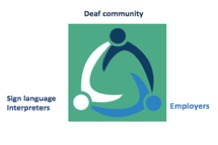 Figure 1: Triangulation of
perspectives on deaf employment
Figure 1: Triangulation of
perspectives on deaf employment
The key research questions that we explored
were as follows:
1) What are the experiences of post-qualified deaf signers in gaining, maintaining or progressing in employment?
2) What are the experiences of sign language interpreters when working with deaf signers in employment settings?
3) What are the experiences of employers in recruiting, employing and supporting deaf signers in the workplace?
1.3.1 Identifying an issue or problem to study
The DESIGNS team was concerned with the
situation of deaf signers in employment. In our early consortium meetings, we
came to the conclusion that work to date that concerned deaf people and
employment had typically focused on the important cohort of deaf signers who
had had limited access to education, which, in turn had impacted on employment
progression. However, no work to date had been carried out in Europe that
focused specifically on how deaf graduates fare. We teased out what we meant by
‘graduate’, determining that it would mean any individual who had completed a
post-secondary programme of education at tertiary level (e.g. vocational,
college or university level education). This allowed us to narrow the scope of
our study and consider the target stakeholder groups whom we wished to engage
with.
1.3.2 Gathering and reviewing related information
We completed a literature review of the key literature insofar as it was accessible to us (see Chapter 2). We note that there has been very little empirical research completed on this topic to date in academic circles in Europe. Indeed, on the whole, we found a notable absence in the literature about the experiences of deaf signing employees. We also noted that there was no in-depth analysis of the intersection between the right to interpreters in employment settings and the experiences of deaf people in the workplace, though this was something that had been referenced by the European Deaf Youth Association. They note that:
“The most crucial barrier between deaf
and hearing people is communication. This lack of accessibility to sign
language interpreters results in too many Deaf young persons being excluded at
work. A sign language workplace is a prerequisite for more and more deaf
entrepreneurs…” (European Union of the Deaf Youth (EUDY), 2016: 2)
1.3.3 Developing a plan of action
Developing our plan of action entailed securing research ethics approval from our institutions (School of Linguistic, Speech and Communication Sciences Research Ethics Committee, Trinity College Dublin, School of Social Sciences Human Research Ethics process in Heriot-Watt University and at Humboldt-Universität zu Berlin).
To this end, the team sought to gather both quantitative and qualitative data in order to answer the research questions as outlined above. Firstly, a questionnaire was developed by the European Union of the Deaf for distribution to their member associations, seeking to explore the view of national associations of the deaf with respect to employment of deaf signers across the European Union territories (See Chapter 3, §3.3). Secondly, qualitative data was collected from the key stakeholder groups through interviews and/or focus group meetings which were carried out in a local sign language, namely British Sign Language (BSL), German Sign Language (DGS), Irish Sign Language (ISL), or in International Sign (IS), or spoken language (English, German) as required (see Chapter 3, §3.4).
To secure research ethics approval, the team had to clearly lay out their hypotheses and how they sought to test them. We focused on several hypotheses that we wished to test with regard to the situation of deaf graduates who are signers:
1) That deaf graduates are significantly more likely to be underemployed or unemployed than their hearing counterparts, despite similar levels of qualification.
2) That deaf candidates for employment are concerned about disclosing their hearing status for fear of experiencing discrimination.
3) That interpreters are inadequately prepared for interpreting in employment related settings, particularly when working within specialist fields (terminology, specificity of concepts used in field, etc.)
4) That interpreting provision is seen as an administrative and economic burden.
5) That the lack of statutory provision of interpreting in employment settings in some countries (e.g. Ireland) inhibits career progression for deaf employees.
On securing research ethics approval in
each of our respective universities, we were ready to move to stage 4 of an
action research project, implementation.
1.3.4 Implementing the plan
Across 2017 and 2018, the DESIGNS research team
gathered data from key stakeholders using deaf-friendly and ethical approaches
to conducting research with deaf signers, and analysed the same using a process
to identify key themes that emerged in the data set (see Chapter 3). Having
completed the data collection, data was transcribed and then shared with
participants to allow them the opportunity to correct/modify/add to their
contributions. With the final agreed transcripts in hand, we then set about
analysing the data for key themes.
1.3.5 Evaluating results
We approached our cross-national data set using thematic analysis. This approach sets out to identify patterns within the data. In our case, we looked at each interview/focus group transcript individually, then on a within-country stakeholder-by-stakeholder basis (i.e. we looked at the Irish data for deaf stakeholders, the UK data for deaf stakeholders, and the German data for deaf stakeholders individually, and then shared our findings with each other, reviewing our own data sets again in light of our discussions). We followed the same protocol for other stakeholder groups (see Chapter 4 for results). Such recursive approaches to coding is typical of qualitative approaches.
Key themes emerged relating to five key domains: (1) barriers to employment/to, or as a result of interpreting provision; (2) strategies employed by key stakeholders; (3) familiarity (with the job, with each other (as a positive and a negative aspect); (4) the role of the interpreter; (5) perceived training needs for deaf people, employers and interpreters.
We also found a mapping between these themes and pathways in employment, namely:
1) Applying for a job
2) Probation
3) 1:1 meetings
4) Group meetings (with sub-categories)
5) Progression pathways
6) Conflict (initiated by a deaf employee/a disciplinary issue-employee led)
7) Social settings
1.3.6 Repeating the cycle with a revised problem or strategy derived from what was learned in the first cycle, until the question is answered
In 1.3.5, we noted that recursivity is
a feature of qualitative data analysis. This revisiting of data is important to
facilitate nuance, and to allow the research team to think about the data in
different ways: coding is not a mechanism for simplifying data, but rather for
identifying categories, and in some approaches, generating theory (see Glaser,
2001, 2003, 2005).
Our goal in collecting and analysing data had both a research goal – to provide a snapshot of the situation for deaf signers insofar as we could, and from this snapshot, inform our DESIGNS project course content, which seeks to offer training for deaf people, employers, and interpreters with the goal of improving the experience of key stakeholders in recruitment, employment and promotion. Arising from this, we hope to shake up the system a little, helping to create more space for deaf graduates who are signers to excel in employment settings, regardless of their field.
1.4 Structure of this report
This research report provides an overview of the
results in relation to each of the research questions and hypotheses, with
illustrative examples from the perspectives of deaf signers, interpreters and
employers on deaf employment experiences in Europe. In what follows, we present
the data from the various aspects of the study undertaken, which provided us
with an overview of the lived experience for deaf signers in Europe in terms of
their access to employment through sign language interpreters. First, we
provide a review of relevant literature, which foregrounded our own study,
followed by a description of the methods and a presentation of the results.
Finally, we make recommendations for best practice in deaf employment settings.
Chapter 2: Literature Review
2.1 Introduction
This report presents the results of an international literature review of the situation for deaf people relative to their employment status. We refer to academic research, policy documents and national data, mapped against frontline service provision in place. We attempt to tease out implications from the available data regarding what this means for deaf signers in the labour market in Europe, and particularly, in the countries engaging in the DESIGNS project. We note at the outset that across this report we frequently include reference to both deaf and hard of hearing people, rather than simply those deaf people who are signers (our target group). This is because even where figures relating to deaf peoples’ employment are available, they tend to be conflated with data for those with a ‘hearing disability’. That is, typically there is no breakdown of data available to indicate whether someone is a signer or not, but rather, reference is made only to hearing status (e.g. as per the Irish census figures (CSO 2011)). Sometimes deaf signers are included in an even broader grouping of people with ‘visual and sensory disability’ (e.g. Watson, Banks and Lyons, 2015). Where possible, however, we extrapolate data relevant to sign language using deaf people.
Because of this tendency to conflate
categories, what we can say is that there is surprisingly little empirical data
that relates to the position of signers and employment; be that job seekers,
graduate-entry employment, those in employment, underemployment issues,
unemployment levels, or re-entry to the job market. There are also questions
relating to the intersection between, for example, age, gender, race,
disability, and religion, that need to be considered, but which are absent from
most of the published data.
Given this situation, we concur with Houston et al. (2010: 9) who note that researchers “have been unable to draw conclusions about labour market conditions for people who are deaf or hard of hearing because surveys of individuals with disabilities do not sufficiently sample these groups”. Despite these challenges, we envisage that this study will be useful in presenting a collated analysis of the available data, and in presenting the gaps that remain to be explored.
We have focused our literature review on
national and international literature and data published from 2000 onwards. We provide
an outline of both qualitative and quantitative findings on employment outcomes
for deaf people, workplace barriers described, and accommodations required by
law within working environments. We carried out library-based research and we
also engaged with governmental organisations, governmental census bodies where
applicable, and deaf-led organisations, as well as interpreting agencies. We begin by providing a country-by-country
overview, before turning to present an analysis of the key themes emerging.
2.2 Scotland / UK
Scotland is the only nation in the
United Kingdom that has legislation on British Sign Language, a recognition
that followed from a long and successful campaign by the Scottish Deaf
community (De Meulder, 2017). While it is too early to assess its impact on the
employment prospects for deaf people in Scotland, there is sufficient
statistical information to illustrate the current employment situation of deaf
BSL users in Scotland.
The 2011 national census in Scotland demonstrates that there were more than 12,000 people who used BSL at home. There is, however, a discussion surrounding the reliability of such figures as not all BSL users will be deaf themselves. It has been suggested that a figure of 2,618 deaf BSL users is a more accurate figure for Scotland, and 72,000 for the UK generally (BDA, 2014); however, it is widely acknowledged that the reliability of these numbers is also questionable (Cassiopeia Consultancy n/d).
As in the rest of the UK, Scotland has an excellent state support scheme known as Access to Work (AtW). AtW aims to assist people with disabilities in the labour force. Individuals can be self-employed, in paid employment, or due to start a job. AtW offers financial support to people to use reasonable accommodation to enable them to work unhindered as much as possible. AtW funding encourages employers to recruit and retain disabled people, however, it has to be pointed out that in some cases the employer will share the cost (British Government Access to Work Guide n/d).
In order to avail of AtW, advisers have access to independent specialist assessors who can identify appropriate solutions to suit the customer’s need. Advisers usually work with the customer and their employer to give the correct support. Costs for this regard have to be agreed in advance. General regulations of applying for the AtW are as follows: AtW will consider paying grants of up to 100% for up to £59,200 per person (capped budget, 2019):
• self-employed people
• people who have been working for less than six weeks when they first apply for Access to Work.
• the Mental Health Support Service
• support workers
• additional travel to work and travel in work costs
• communication support at interviews
The level of grant will depend on factors like whether the person is employed or self-employed and how long they have been in their job the type of help required. There are a number of principles that underpin the Access to Work scheme, namely:
1) Above and beyond a reasonable adjustment: Support that complements but does not replace or subsidise an employer’s legal duty to make reasonable adjustments;
2) Additional costs: Support that is over and above what a non-disabled person would need to do their job;
3) When determining whether there are additional costs or a business benefit: Consider the support required by a disabled person doing the job. Do not take into account the cost incurred by a non-disabled person doing the job;
4) Meeting minimum needs: Support that allows individuals to overcome workplace barriers that arise from their disability and;
5) Value for money: Support that meets an individual’s needs in the most cost-effective way for the taxpayer (British Government Access to Work: Staff Guide n/d).
For deaf employees, annual budgets are allocated every year to pay for interpreting or other types of support e.g. equipment, notetakers. Interpreters may be paid directly by the Department of Work and Pensions on receipt of AtW forms, or, a company can pay interpreter fees upfront and claim back AtW funding on a monthly basis from the Department of Work and Pensions.
The positive effects from AtW for the
whole economy cannot be overstated as John Walker pointed out at a rally in
2015 opposing the potential cutbacks to AtW that were proposed at that time:
“Today, we are here to defend the best
scheme ever created: Access to Work. It allowed disabled people to dream and
work in places they never thought they could. We entered new professions and
climbed the ranks. Access to Work gave us equipment, transport, assistance and
sign language interpreters – it enable deaf and disabled people to become
socially mobile, climb out of poverty, earn good money and be successful. Sayce
report said that for every £1 spent, the Treasury receives £1.48 back. Access
to Work is good for deaf and disabled people, good for the Treasury and good
for the economy. So why are there changes?” (Walker, 2015)
The Sayce Report (2011: 105) made
several key recommendations, including the following: “the Department should,
in general, be funding individuals’ support costs – so that disabled people can
participate in every type of employment, from working for a mainstream employer
to setting up their own business or working in a social enterprise or mutual –
rather than funding disability-specific facilities, like Remploy
factories”.
It remains to be seen if this
recommendation has been fully implemented. Having explained the AtW in the
background, the statistical information concerning Scottish BSL users in
employment does not make for happy reading according to the Scottish
Government. Among the findings that was based on the latest census in Scotland,
BSL users in 2011 were:
· Less likely to be economically active, and more likely to be 'permanently sick or disabled';
· More likely to be employed in 'Public Administration, Education and Health' industries;
· Much more likely to have never worked;
· More likely to work fewer hours per week;
· Less likely to be in the highest AB social grade;
· More likely to have no qualifications, and less likely to hold high level qualifications;
· More likely to have no access to a car or van, and less likely to have multiple cars. (Scottish Government, 2015).
Based on these findings, it seems that solutions have to be beyond the structural supports (i.e. financial supports/grants) as the Sayce Report points out that it could be a matter of societal attitudes towards BSL users in Scotland to be substantially addressed. However, Cameron (2013) points out that 20% of deaf respondents to her research were not aware of the existence of the AtW scheme. She also reports that almost half of the employers who were surveyed in her research and who had availed of the scheme, learned of its existence from deaf employees themselves (Cameron, 2013: 138-139).
There are concerns that AtW tends to
focus on work-related business and tends to undervalue or underestimate the
value of social aspects of work which are crucial to the successful employment
in work, something that sadly follows from school experiences. Bristoll and
Dicksinson (2015: 6) argue:
“Deaf lack of access to the more
social aspects of discourse will most likely start in school, where curriculum
content will be prioritised at the expense of classroom humour and phatics”
(Bristoll & Dickinson, 2015: 6)
Ignoring the social aspects in employment has possible implications for the wellbeing of deaf employees. Dickinson (2014) suggests that since the Access to Work funding was made available, provision of sign language interpreters in the workplace has led to increased social interaction for Deaf employees. As Walker (2015) suggests that there is a better return to the Treasury through deaf taxpayers. Dickinson and Bristoll have demonstrated that benefits are not necessarily only financial, but that there are cultural and social benefits too. It appears from their research that the social and cultural benefits from the AtW for deaf employees are seriously underestimated and to some extent, undervalued. Additionally, there are reports of bureaucratic limitations to those who wish to avail of the AtW scheme. For example, previously, advisors met applicants to assess support needs, but such in person assessment has now been replaced by conversations that take place only via telephone and email correspondence.
Currently, there is a concern about having to apply within 6 weeks of starting a new job. Most of the applicants are not in a position to predict their work plan and schedule for the year ahead at this early stage of new employment. For instance, an applicant would not know what to expect in the forthcoming year, the frequency of interpreter provision required or the number of meetings they will need to attend. Deaf people who are self-employed also report difficulties in getting AtW approval for interpreting costs to attend ‘non-paid’ meetings that they might need to attend in order to secure a contract. Given such lack of clarity and unpredictability, applicants can experience anxiety and stress, and they report that engaging with the process is extremely time consuming (Audrey Cameron, personal communication, January 2019). Moreover, applicants have to renew their applications every 1-3 years, and the onus is on the users of the scheme to renew their application.
This anxiety is not just evident for deaf signers who are starting a new job. Kyle (1996), Young and Ackerman (1996), and Young, Ackerman and Kyle (2000) have previously noted the challenges that deaf people have in developing effective work-based relationships with hearing colleagues, even in work environments where hearing people can sign. In the Translating the Deaf Self project (Napier, Young & Oram, 2017) conducted interviews with deaf community members, deaf professionals, interpreters and hearing colleagues of deaf signers, and found that deaf professionals in particular experience feelings of insecurity at work depending on their level of familiarity with an interpreter (Young, Napier & Oram, under review), and they utilise different strategies in order to assert their agency in the workplace and ensure that their ‘voice’ is heard (Napier, Young, Oram, & Skinner, 2019). The interpreters that were interviewed also acknowledged levels of anxiety, and a sense of responsibility in ensuring that they represent deaf professionals accurately when interpreting from a signed into spoken language, and discussed the importance of developing relationships and trust with the deaf signers that they work with (Napier, Skinner, Young & Oram, in press). Finally, hearing colleagues also noted a level of anxiousness in their recognition of the fact, that even if a sign language interpreter is present, it can be difficult to feel ‘directly connected’ to their deaf colleagues (Young, Napier & Oram, 2019).
Furthermore, even with the provision of interpreters through the AtW scheme, Bristoll (2009) noted that deaf signers experience a ‘glass ceiling’, because even when a sign language interpreter is provided through AtW, they may only be present for formal meetings at work and not for the social networking that is vital for making connections in order to progress at work.
In her seminal study of the role of sign language interpreters in the workplace in the UK, Dickinson (2014) notes that interpreters perceive that deaf people often struggle with how to blend into the workplace, and are not always sure how best to utilise an interpreter to facilitate their workplace relationships. She also noted challenges in terms of interpreter role, boundaries, and interactions with deaf and hearing employees, and that interpreters have to take on a multiplicity of roles. Dickinson also found that understanding the discourse of the workplace, and not just the job-related terminology, also presents a challenge for interpreters.
It is evident from the review of literature concerning deaf signers and their employment in Scotland and the UK that it is not without difficulties in spite of the presence of the Access to Work scheme and the consistent provision of interpreters. In comparing the UK with other European countries, particularly Ireland and Germany, we see a similar picture.
2.3 Ireland
The Republic of Ireland has a
population of 4.8 million (www.cso.ie). We adopt the international rule of thumb used by
the World Federation of the Deaf and the European Union of the Deaf that
assumes that one person in every thousand is a deaf signer (Johnston 2004).
This suggests an estimated 5,000 deaf ISL users in the Republic. It is important
to note that this figure remains contested (Matthews 1996; Conroy 2006; Census
2011).
While the 2016 Census
details 103,676 people who self-reported as being deaf or having a ‘serious
hearing impairment’, the vast majority of these are aged 65 years and above.
They note that numbers reporting deafness has increased 12.6% since the
previous census (2011) where those with a hearing disability comprised 2% of
the population. In 2016, this figure represented 2.2% of the national
population. The CSO also notes a significant increase in acquired hearing loss
amongst men over 50 years of age. The 2016 census data reports that there are
4,226 residents in the State who use ISL, but this does not mean that ISL is
the first language of these respondents. Instead, this number includes deaf,
hard of hearing, and hearing people who use ISL as one of their languages. We
note that it is difficult to gauge just how many ISL users there really are as
there is no question that maps sign language use to deafness/hearing loss in
the census.
Based on these rather
imprecise statistics, we estimate there are an approximate 37,000 deaf and hard
of hearing people aged between 15 and 65 years, which is the age range most
likely to be eligible for employment in the Irish context. The 2016 census
reports that 24,500 of this cohort are in the labour force, while 20% are
unemployed. As per January 2019, the national unemployment rate is listed as
5.3% (www.cso.ie),
and we are considered to be in a position of full employment. Extrapolating
from these figures, we can say that Irish deaf and hard of hearing people seem
to be three and half times more likely to be unemployed than their hearing
counterparts. The 2016 CSO report also states that 23.2% of their respondents
said that as a result of their deafness/hearing impairment, they had a
difficulty with working at a job, business or attending school or college. At
the same time, we also note that as in 2011, the 2016 census figures associate
deafness/'hearing impairment’ with the lowest rate of unemployment for those
considered to have a disability.
In the Republic of
Ireland, the government operates a job interview interpreter grant, the Job
Interview Interpreter Grant Scheme (JIIGS). This can cover both job interview
and training during an induction period when a person starts a new job. The
fund will pay a professional interpreter for a 3-hour period including travel
costs. Applicants have to secure approval from the local employment office for
each job interview they are invited to, and have several parties (prospective
employers, interpreting agency, interpreters and INTREO advisors) sign off on
parts of a form before the interpreting agency/individual interpreters can be
paid. As a result of problems inherent to this process, interpreters are often
reluctant to take on these assignments because of problems in getting paid.
In 2011, the state
funded interpreting referral service, Sign Language Interpreting Service
(SLIS), set up the Irish Remote Interpreting Service (IRIS). This provides an
online video link to an Irish Sign Language (ISL)/English interpreter. SLIS
reports that the Department of Social Protection came to a decision to exclude
coverage of interpretation costs under the auspices of the government-funded
“Workplace Equipment/Adaptation Grant (WEAG)”. However, in 2017 Irish Sign
Language (ISL) was recognised as Ireland’s third official language (though the
Act has not formally been commenced yet, and may not be until late 2020, early
2021) (Government of Ireland 2017). The Irish Sign Language Act 2017 provides
for interpretation into ISL by public bodies and specifically outlines that
remote interpretation may be used to meet the obligations of a public body,
with the permission of the service user.
Of particular
relevance to this study, we note that IRIS has also had some success in
facilitating access to local level engagement for deaf ISL users with key
government services that support access to employment. However, it appears that
there has been a drop off in rate of engagement with IRIS from this sector in
the past year or so. We cautiously interpret this as a sign that at the tail
end of the recession, deaf people were engaging with state services (who, in
turn, drew on IRIS), to seek (re)entry to the workplace, but now that
employment levels are high, there may be fewer deaf people actively seeking
work via the state services. Of course, it may also be that other factors are
at play too and that they intersect in this regard.
In 2015 the
government launched their “Comprehensive Employment Strategy for People with
Disabilities 2015-2024”. The key goal of this plan is to increase levels of
employment amongst people with disabilities as a priority, and to address the
barriers and challenges that impact on employment of people with disabilities.
A main service
provider working with deaf and hard of hearing people is Chime (previously
“DeafHear”). They argue that Deaf Awareness Training (DAT) is an important
element that needs to be considered in supporting deaf and hard of hearing
employees in the workplace. Employers can apply for grants that cover up to 90%
of the cost of awareness training for employees. In such instances, funding is
provided by the State, and grants are available for the following
employment-related activities: job interviews, wage subsidy, workplace
equipment adaptation, personal readers, disability awareness training, and
employee retention.
Other than the
information reported on thus far, the most recent source of quantitative data
on deaf people in employment in the Republic of Ireland comes from the results
of last two national censuses, conducted in 2011 and 2016. These provide
information about the number of deaf and hard of hearing people in Ireland across
a range of domains (education, employment, housing, health, etc.). For our
purposes, we note that 64.2% of men and 50.9% of women who have ‘deafness or
serious hearing impairment’ are in employment. Unfortunately, the data provided
doesn’t specify if the respondents were signers or not, which makes it
impossible to tease out how the data set reflects the specific experiences of
Irish Sign Language users. Further, there is insufficient data available to us
to determine the associations between educational attainment and employment for
deaf people. This is because the data presented by the CSO around educational
achievement conflates all disability groups, noting that for disabled persons
aged 15 – 50 years (inclusive), 13.7% had completed no higher than primary
level education, compared with 4.2% of the general population. The CSO
report goes on to note that people with a disability were less likely to
complete third level education (37% are educated to this level, compared with
53.4% of the general population aged 15-50 years (inclusive) (CSO 2016).
Educational
attainment is highly indicative of employment outcomes in Ireland. OECD figures
show that tertiary educational attainment in Ireland is much higher than the
OECD average and reached 53% of young adults (25-34 year-olds) in 2017 compared
to 44% across the OECD. We compare this with an estimated 10% of deaf signers
who complete tertiary education in Ireland (Leeson, 2012). In Ireland,
employment rates are higher for tertiary-educated men than for women, but this
gap narrows among younger adults. In 2017, the employment rate in Ireland was
85% for tertiary-educated adults, (which is also the OECD average) and it was 9
percent points higher for men than for women (90% compared with 81%), the same
gap as across OECD countries overall.
If we compare this to
what we know of Irish deaf people engaging with tertiary education, we can say
that even where deaf people wish to consider re-training or further education,
they tend not to take up full-time study, opting to stay in low-level posts
instead, as they are fearful of losing steady employment (Leeson and Matthews
2001). They are also mindful of negative educational experiences at primary and
post-primary level, and often have low levels of confidence in their own
abilities, which in turn makes it difficult to attract deaf students to third
level education, even where increased incentives are in place to support mature
students, students with disabilities and those from disadvantaged communities.
In reviewing studies
that have been conducted in Ireland with respect to deaf people and employment,
Conroy (2006) examined the educational background and employment status of 354
Irish deaf people, 198 who were in paid employment and 39 who were unemployed. She found that deaf adults
were concentrated in lower level clerical and manual posts with very low levels
of pay, leading her to suggest that many deaf people can be considered to be
‘working poor’. Further, deaf people do not readily move jobs, do not seek or receive
promotion and experience vertical and horizontal blockages to movement in the
jobs market.
In relation to job
searches, some deaf people reported using recruitment agencies, while a
minority used specialised public sector or publicly funded placement agencies.
In order to understand better the situation within the working environment, the
survey investigated whether deaf people had had the possibility to be promoted.
74% of participants had never been promoted while 80% said that they had never applied
for a promotion (Conroy, 2006: 40). Communication preference was another issue
considered in Conroy’s report. Half of the participants in her study report
that they used lip-reading and speaking as their main method of communication
in the workplace because interpreters were not available.
The most significant
aspect of the Conroy report is the fact that clear links are drawn between
educational disadvantage and negative employment outcomes for deaf people in
Ireland, though as Leeson and Sheikh (2008) note, this trend also holds across
Europe (see EUD, 2001; Kyle & Allsop, 1997). Writing in 2006, Conroy noted
that while employment rates for deaf people in Ireland are only marginally
below those of hearing people, (64% as the national average, 60% for Deaf
people), unemployment is much more significant for deaf people: Deaf
respondents experienced four times the national rate (3% national average, 12%
for deaf people), dispelling the myth that ‘people with an impairment’ are
economically inactive’ (Conroy, 2006:
46), although their income levels are very low.
Focusing on the lived
experiences of Irish deaf women, Coogan and O’Leary (2018) surveyed of 301
Irish deaf women from across the island of Ireland aged 18 to 90 years. One of
the elements that they explored was Irish deaf women’s experience in employment.
They included questions around how participants secured employment; job
satisfaction rates, status, and income level and reflects the most up to date
focused consideration of the employment situation of deaf people in Ireland.
Fewer than half of Coogan and O’Leary’s respondents are currently employed
(n=135), which is in line with the 2016 census figures. Factoring out students
(n=17), those who are retired (n=48) and homemakers (n=23), 44.8% (n=135) are
employed, and only 45 respondents are unemployed. In sum, they found that:
there were issues with career guidance, as they often relied on family and
friends for assistance; only a small proportion hold ‘professional class’
occupations (reflecting findings from a previous study by Conama and Grehan,
2002); deaf women tend to occupy lower paid jobs (but this trend was changing);
deaf women take up the opportunity of working through community assisted
schemes; but they report lack of choice in the types of work offered.
In contrast to the
perspectives of deaf ISL users, the Association for Higher Education Access and
Disability examined 300 employers’ attitudes to employing graduates with
disabilities in Ireland (AHEAD, 2018). Although the report discussed disabled
people generally, for the purposes of this report, the responses with respect
to the provision of sign language interpreters are interesting. Only 45% of
employers surveyed considered the provision of interpretation to be a
reasonable accommodation. It seems that interpreters might not be provided because
of the cost of provision (and the absence of any statutory funding or
co-funding for same) or as a result of lack of awareness. Interestingly, this
maps to research in progress, which finds that in the absence of easy to
navigate statutory provision, some deaf people have directly, paid for or
contributed to the cost of interpreting in workplace settings (Sheikh, in
prep). Until this DESIGNS project, there had been no focused studies of
sign language interpreter or employer perspectives on deaf people in employment
in Ireland.
2.4 Germany
To date, there are no
official statistics in Germany providing information on the actual number of
German Sign Language users (deaf or hearing). The German Deaf Association (DGB)
estimates that there are approximately 80,000 deaf people whose preferred
language is German Sign Language (DGS). However, there have been discussions
about that number not being accurate (e.g. An article published in the German
Deaf Magazine suggests that there might be less than 80,000 deaf DGS users).
There are several
laws in Germany to prevent discrimination of people with disabilities in a wide
range of life areas, among them work-related areas. These laws are: Grundgesetz
(Constitution for the Federal Republic of Germany), SGB IX (Social Security
Code IX), BGG (Act on Equal Opportunities for Persons with Disabilities), and
AGG (General Equal Treatment Act). Since Germany is a federal republic, there
are additional, specific regulations at the state level, the so-called
„Landesgleichstellungsgesetze” (Act on Equal Opportunities for Persons with
Disabilities for the federal states). In 2017, the first phase of reforms of
the controversial „Bundesteilhabegesetz“ (Federal Participation Act) has
entered into force. It was designed to align the United Nations Convention of
the Rights of Persons with Disabilities and amends several laws with the goal
of strengthening self-determination, non-discrimination, and participation in
society of people with disabilities. The law will be implemented in several
steps, and the impact for inclusion of people with disabilities in every aspect
of life, such as the labour market, has yet to be explored.
Based on SGB I, IX,
X, BGG, and KHV (Communication Provision Regulation), deaf people have the
right to use sign language to access public services in public domains
(including employment, healthcare, social welfare, federal and state offices,
police, court, etc.). To increase their participation in society, deaf people
can request provision of sign language interpreters. However, financial support
for required services is provided only “under specific circumstances”, which is
vague and might curtail deaf peoples‘ rights. For private and voluntary
activities, interpreter costs are generally not covered, thus requiring deaf
people to pay interpreters themselves. In the workplace, deaf people have the
right to receive work assistance, which includes sign language interpreting
services.
There are various
forms of state support programs for deaf employees and employers, such as work
assistance, assistive technology, reasonable accommodations, and wage subsidy
programs. Since 2000, deaf people (like other people with ‘severe
disabilities’) have the right to receive work assistance
(Bundesarbeitsgemeinschaft für unterstützte Beschäftigung, n.d.). People who
use work assistance can be self-employed or in paid employment or due to start
a job. There are some rules for requesting and accessing work assistance:
· The deaf person must be capable of accomplishing the main parts of the job on their own. The work assistance should only assist with tasks the employee is not able to complete due to being deaf. This often entails interpreting or relay services for meetings, consultations, phone calls, etc., with hearing people who cannot sign, and also assistance with written assignments/reports.
· It is the deaf person’s responsibility to guide and instruct the work assistance and to organise the assistance’s work. The Deaf employee receives a specific monthly budget to cover individual needs.
· The deaf person can either employ the work assistance or assign a service provider to employ the work assistance.
People with
disabilities have the right to be employed in an accessible environment. One
way to create an accessible work environment is by providing assistive
technology and measures that are known as ‘reasonable accommodation’. The goal
is to identify and increase existing abilities within the customers (e.g., by
amplifying sounds in a loud environment) or to replace lacking abilities (e.g.
providing visual alerts instead of acoustic signals). In order to provide
appropriate support and to meet the customer’s needs, specialised assessors
from the rehabilitation organisations or the integration offices advise both
employers and deaf employees. The required financial support for technical
devices and reasonable accommodation is either paid directly to the deaf
employee or to the employer.
Employers can receive
wage subsidy if they provide vocational training or employment to people with
disabilities. Also, if they create new jobs for people with disabilities or if
they provide appropriate measures to make existing workplaces accessible. Employers
can also be reimbursed for providing probation time (up to three months) for
people with disabilities. The actual amount of financial support depends on
several factors and thus differs individually. Companies that employ a specific
percentage of people with disabilities are exempt from compensatory payment.
There have been
previous studies on deaf people’s experience in the labour market in Germany
(see e.g. GINKO, 2011-2013; EGSB, 2013-2016). The overall goal of the GINKO
study was to examine deaf people’s knowledge on their rights regarding
inclusion in the labour market and implementation of legislation. The results
showed that implementation so far is limited. For example, only 10% of the
participants made use of work assistance. Also, the data showed that deaf
people have limited knowledge on the rights they are entitled to and the
support available to them. 25% of the participants reported they do not know
any of the relevant acts and regulations (such as SGB IX, BGG, AGG, Convention
of Rights for People with Disabilities). In other words, many deaf people do
not claim their rights because they do not know current legislation. Results
also suggested that deaf people were more likely to make use of work assistance
if they knew legislation and had received information through integration
offices. Moreover, as the GINKO-project
indicated, the most important source of information for deaf people were
friends and family, revealing that sources of information available through the
‘Integrationsfachdienst’ (Integration Special Service) need to be enhanced.
The goal of the EGSB
study was to examine supporting factors that lead to successful working lives
for Deaf and hard of hearing people. Regarding social factors in the work
place, good relationships with colleagues and support from supervisors were
considered crucial (e.g. encouraging further training and education). Regarding
usage of state support, the results showed that only half of the participants
used interpreting services (sign language and written language) and out of 32
participants, only 3 made use of work assistance.
Germany has legislation whose aim is to
increase deaf peoples‘ inclusion in the labour market. However, there are
deficits when it comes to implementing these laws. In a recent position paper
on work assistance, the German Deaf Association claims that long processing
time and unjustified rejections of applications for state support are some of
the biggest barriers to Deaf peoples‘ employment (DGB, 2018). To solve this
problem, the German Deaf Association suggests providing a general amount of
money during the crucial probation period where Deaf employees can demonstrate
their actual skills.
2.5 Summary
This overview of the
literature presents key findings reported in academic, state, deaf community
and other related sources that pertain to deaf signers in workplace settings.
Where information was available on sign language interpreter or employer's
perspectives, this was also included. What we find is that deaf people are less
likely to be unemployed than other groups considered ‘disabled’ for the purpose
of government censuses. However, given the conflation of data for deaf and hard
of hearing people in state figures, we cannot say, quantitatively, how deaf
signers fare in the workplace. We also cannot get to state figures that
reliably tell us how signers fare in tertiary education and to what degree this
impacts on employment outcomes in comparison to their hearing peers. However,
the studies we have surveyed in the UK, Ireland and Germany, clearly illustrate
that there is significant under-employment in deaf communities, and a great
deal of dissatisfaction as regards employment status.
Some of the barriers
we have reported relate to broader societal perceptions of deaf people, which
impact on how a deaf job candidate is perceived, and which show up with respect
to career guidance and employer assumptions. Others relate to systemic barriers,
often in contexts where the system intends to support access, for example, with
respect to the process associated with securing the grant for interpreters in
job interviews.
Issues raised in the
academic literature from the UK about notions of representation, interpreter
preference, and the importance of developing strategies for working with
interpreters have also been considered by international deaf leaders (Haug, et
al, 2017) and deaf academics (Burke, 2017; De Meulder, Napier & Stone,
2018); and the key issues of trust, responsibility and relationship building
have also been identified by deaf signers and interpreters in Australia
(Napier, 2011) and the United States (Miner, 2017).
Thus the literature
reveals that although there is evidence that more deaf signers are achieving
post-graduation employment, there are still endemic challenges. It is therefore
crucial to improve information on employment options for deaf people by those
who already participate in the work life and who may act as ‘role models’ or
‘ambassadors’ for other employees; as well as increasing understanding of best
practices for working with interpreters in employment settings.
Chapter 3: Methodology
A mixed-methods
research design (Cresswell, 2003) was adopted in order to enable an in-depth,
triangulated, exploration of the experiences of key stakeholders in relation to
deaf people employment and access through sign language interpreters, namely:
deaf signers, sign language interpreters, and employers. Our focus was on deaf
people who have finished school and have post-school qualifications, obtained
either through a vocational, college or university programme.
Using mixed-methods
enables triangulation of research data using a combination of different
approaches, in order to explore the same phenomena from different perspectives.
The use of mixed-methods research designs in interpreting studies are
appropriate in order to account for the level of complexity in exploring
interpreting processes and practices (Napier & Hale, 2015).
Furthermore, we aligned
our research with principles of community participatory research (Cornwall
& Jewkes, 1995) as the overarching conceptual framework for the study.
Community participatory research has relatively recently become an established
and effective methodology with deaf signers (Barnett, et al, 2011; Emery, 2011; Graybill, et al, 2010; Leeson,
et al, 2017; McKee, et al, 2012; Napier & Kidd, 2013; Napier &
Sabolcec, 2014; Napier, Young & Oram, 2017; Sutherland & Young, 2013)
and is newly emerging in interpreting research as a way to rebalance power by
including community users in the scrutiny of interpreting practices (Wurm &
Napier, 2017). Participatory research enables positive user involvement, and
enables marginalised ‘hidden’ voices to be heard. Through purposeful sampling
(Patton, 2002), ‘information rich’ stakeholder groups who have a depth of
experience to share contribute to the research process.
3.1 A note on doing research with signing deaf communities
The Sign Language Communities’
Terms of Reference, originally drawn up in the USA, outlines six principles for
conducting research ethically with deaf signers (Harris, et al., 2009):
1) The authority for the construction of meanings and knowledge within the sign language community rests with the community’s members.
2) Investigators should acknowledge that sign language community members have the right to have those things that they value to be fully considered in all interactions.
3) Investigators should take into account the world-views of the sign language community in all negotiations or dealings that impact on the community’s members.
4) In the application of sign language communities’ terms of reference, investigators should recognise the diverse experiences, understandings, and way of life (in sign language societies) that reflect their contemporary cultures.
5) Investigators should ensure that the views and perceptions of the critical reference group (the sign language group) is reflected in any process of validating and evaluating the extent to which sign language communities’ terms of reference have been taken into account.
6) Investigators should negotiate within and among sign language groups to establish appropriate processes to consider and determine the criteria for deciding how to meet cultural imperatives, social needs, and priorities.
Thus, the study was
designed to specifically take the above Terms of Reference into account. This
was achieved in part due to the fact that the research team is comprised of a multilingual, mixed deaf-hearing team of signers and
interpreter practitioners. But more importantly, in keeping with principles of
ethical research practices, transparency and accountability in conducting
action research with signing deaf communities (Leeson, et al, 2017), we
communicated about the research in sign language, involved deaf signers, and
plan to disseminate the final research findings in several signed languages.
3.2 Methods
The specific methods of data collection involved:
· A Europe-wide online survey to scope the landscape of deaf employment from the perspective of national deaf associations;
· Focus groups and one-to-one interviews with deaf employees from various public and private sectors in the UK, Ireland and Germany;
· Focus groups and one-to-one interviews with employers/organisations that have deaf employees in the same countries; and
· Focus groups and one-to-one interviews with interpreters who work regularly in employment settings in the same countries.
Here we provide an
overview of each method and break it down by country, as there were minor
variations in the make-up of participants, process of recruitment and the
procedure of data collection.
3.3 Survey
In 2017, the European Union of
the Deaf (EUD) distributed information about an online questionnaire to their
member associations ahead of their General Assembly (GA) in Malta. The survey
instrument consisted of 11 questions in written English. The goal of the survey
was to collect descriptive statistical information about access issues for deaf
people in employment settings across Europe from the perspective of organisations
that represent deaf sign language users in different countries. Questions
covered the following issues: what are the perceived issues that need to be
researched with respect to deaf employment; whether sign language interpreters
are typically provided in job interviews and workplaces; whether remote
interpreting services are used for employment settings; if accommodations for
deaf sign language users are generally met; if any employment advocacy services
are available for deaf sign language users; and resources needed to support
deaf sign language users to obtain a job and maintain and progress at work. The
questionnaire was developed in consultation with consortium partner members, by
drawing on key issues in the literature and based on survey data that had been
collected in the other individual countries. To the knowledge of the
consortium, this was the first cross-Europe survey that had been conducted on
deaf employment.
3.3.1 Participants and
recruitment
Potential participants
were national deaf associations across Europe who are members of the European
Union of the Deaf. A total of 31 associations were invited to respond to the
online survey. Invitations were sent by email to the key contact person in each
organisation, and representatives were also invited to complete the survey at a
general meeting of the European Union of the Deaf, when the survey was
explained in International Sign. At this time, if requested by individual
member representatives, the survey questions were also explained in International
Sign.
In total, 16 responses
were secured from national associations of deaf people in Austria, Belgium
(Fevlado - Flemish), Belgium (FFSB - Wallonia), Czech Republic, Denmark,
Finland, Germany, Hungary, Iceland, Ireland Latvia, Malta, Netherlands, Poland,
Portugal and Romania. A descriptive analysis of the survey responses was
conducted to identify an overall pattern of the experience for deaf signers in
gaining access to employment across Europe. A survey return rate of 50% is
adequate, 60% is good, and 70% is very good (Babbie, 1973). The overall return
rate in this study was 51%.
3.3.2 Survey analysis
A descriptive analysis of the
survey responses was conducted to identify an overall pattern of the experience
for deaf sign language users in gaining access to employment across Europe. An
overview of the findings can be seen in Chapter 4, §4.1.
3.4 Interviews and focus groups
In order to examine
the lived experiences of deaf signers in the countries represented by the
consortium partners in more depth, a range of semi-structured one-to-one
interviews and focus groups were held with key stakeholders, namely: deaf signers,
interpreters and employers. The goal of these interviews was to elicit
information about the experiences of: post-qualified deaf signers in gaining,
maintaining or progressing in employment; sign language interpreters when
working with deaf signers in employment settings; and employers in recruiting,
employing and supporting deaf signers. Interviews were conducted in England,
Scotland, Ireland and Germany. Participants were recruited through network and
purposive sampling by the country-based research team members and interviews
were held in the spoken or signed language of the respective countries,
dependent on the participant group.
Interview questions
were developed by the consortium so that consistent questions would be used
across each country. Deaf signers were asked: to describe their employment
history and qualifications; any barriers they felt they faced in gaining a job
or career progression; their experience of working with interpreters; how
interpreters are booked, who pays for them and any issues with government
funding (if it is available); their perceptions about the role of the
interpreter in the workplace; the nature of their interactions with hearing
colleagues at work; training needs for hearing colleagues; and any other issues
for consideration. Interpreters were asked parallel questions about: their
experiences of interpreting in the workplace; how they get booked and who pays
them; any problems receiving remuneration; how they perceive their role in the
workplace; typical patterns of work when interpreting in employment settings;
perceived barriers for deaf people in the workplace; how deaf people interact
generally with hearing colleagues; challenges of interpreting in the workplace;
how they feel about interpreting for social networking in workplaces; and
training needs. For employers, the questions focused on advantages and
disadvantages of employing deaf signers; equality and diversity policies in
organisations; barriers, accommodations and opportunities for employment and
career progression; booking and payment of interpreters; the role of the
interpreter in the workplace; training needs; and what they would find useful
in an employers guide.
Interviews and focus
groups were scheduled at a mutually agreed time and were conducted either
online by Skype or face-to-face. All interviews were video recorded to capture
the data for later analysis. Interviews with deaf participants were conducted
in British Sign Language, Irish Sign Language or German Sign Language, and with
the interpreters in spoken English or German. The employer interviews were
conducted in both signed and spoken language through professional sign language
interpreters. Although an interview protocol was developed for all the
researchers to use, they were free to explore any additional areas of interest
within the original objectives of the study, in order to follow-up participant
responses in more detail. Interviews lasted between 30-120 minutes (focus
groups tended to be longer).
The spoken interviews
were transcribed. The signed interview video data was imported into ELAN or
NVivo annotation software, and was either translated into English or German, or
directly coded in sign language for analysis. All data was analysed through a
process of thematic analysis: (1) familiarisation
with data, (2) generating initial codes, (3) searching for themes among codes,
(4) reviewing themes, and (5) defining and naming themes (Braun & Clarke,
2006). In order to assure anonymity, participants were allocated a unique code,
which was then used for all subsequent identification. References to specific
individuals or organisations in the interviews were also removed during the
translation process.
Here we present a
snapshot of participants and details of the recruitment process for each
country, followed by information about our approach to analysis. The results
for each country, and a summary of overall themes, are presented in Chapter 4,
§4.2, 4.3 and 4.4.
3.4.1 UK
Due to the potential
spread of participants across the country, a combination of one-to-one
semi-structured interviews and focus groups were organised. Potential
participants in Scotland and England were identified through network and
purposive, non-probabilistic sampling. For deaf and interpreter participants,
an expression of interest was sent out through social media in British Sign
Language (BSL) and English, giving brief information about the project and
asking for people who were interested in being interviewed to make contact with
the research team based at Heriot-Watt University. Deaf people who were either
employed in a range of jobs, self-employed or unemployed, and interpreters
known to work regularly in employment settings, were also identified through
networks and were approached directly with letters of invitation to be
interviewed.
When an individual
agreed to consider being involved, they were provided with information about
the project and a consent and information form. The final breakdown of
participants can be seen in Table 1.
Table 1: British participants
|
|
Total |
Format |
|
Deaf signers |
32 |
13 online interviews/ 19 F2F interviews |
|
7 |
Focus group |
|
|
Interpreters |
7 |
Online interviews |
|
Employers |
9 |
Mixed focus group |
|
5 |
Online interviews |
|
|
3 |
Dedicated focus group |
|
|
Total participant no. |
63 |
|
Of the 39 deaf
participants, 17 were from Scotland and 22 from England; 19 were male and 20
were female. Twenty-six were employed, 10 were self-employed or business
owners, one was both employed part-time and was self-employed, and two were
unemployed. They ranged in age from 18-64, but the majority were aged between
35-54, and held a range of qualifications from vocational (n=1) to Higher
National Certificate (n=1) or Diploma (n=2), a Higher Education Diploma (n=3),
a graduate/postgraduate diploma (n=4), a bachelors degree (n=18), a masters
degree (n=4), a PhD (n=3), teacher of the deaf qualification (n=3), and a
management qualification (n=1). Participants worked in a variety of fields,
including social work (n=2), media (n=4), deaf charity organisations (n=11),
employment (n=1), education (n=4), academia (n=5), interpreter agency (n=2),
health (n=1), IT (n=3), sports (n=2), government (n=2), and the arts (n=2).
The interpreters were
all registered qualified interpreters and worked on a freelance basis; 5 were
female and 1 was male (which is representative of the general interpreting
population, with general estimations of an 80:20 female:male ratio). Three of
the interpreters were in Scotland, and 2 in England. One is actually based in
Northern Ireland but works remotely with a deaf employee based in England. All
six of the interpreters work regularly as designated interpreters with deaf
professionals, and have experience of interpreting meetings, job interviews,
work training sessions, and general office interactions.
The employers were
representatives of a range of organisations, including construction, retail,
deaf charity service organisations, local or national government, academia, and
museum. One focus group included a mixed deaf-hearing group of people from
different organisations, and another was a dedicated focus group with three
people who worked for the same organisation. The majority of employer
participants had direct experience of employing deaf signers.
3.4.2 Ireland
As with the UK situation, due
to the potential spread of participants across the country, a combination of
one-to-one semi-structured interviews and focus groups were organised.
Potential participants in Ireland were identified through network and
purposive, non-probabilistic sampling. For deaf and interpreter participants,
an expression of interest was sent out through social media in Irish Sign
Language (ISL) and English, giving brief information about the project and
asking for people who were interested in being interviewed to make contact with
the research team based at Trinity College Dublin. We published invitations to
participate in the study online (in Irish Sign Language) on the popular “Irish
Sign Language (ISL) Vlogs and Films” Facebook page, with the goal of eliciting
participation from across the Deaf community. We reached out to interpreters
via the Council of Irish Sign Language Interpreters (CISLI), the government
funded service provider, Sign Language Interpreting Services (SLIS), and a
private interpreting agency with national reach (Bridge Interpreting). We
invited employers known to employ deaf signers to participate, and we also took
advice from our partner organisation, AHEAD, following up with industry
partners whom they had engaged with previously. We provided information about
the project to potential candidates via our gatekeepers (in the case of
interpreters/employers) and online (via ISL Vlogs). Consent forms were
completed by all parties interviewed ahead of recording interviews/focus
groups. The final breakdown of participants can be seen in Table 2.
Table 2: Irish participants
|
|
Total |
Format |
|
Deaf signers |
12 |
Focus group |
|
1 |
F2F |
|
|
Interpreters |
6 |
F2F |
|
Employers |
5 |
F2F |
|
Total participant no. |
23 |
|
Of the 13 deaf
participants, 4 were male and 9 were female. 11 were employed, 1 was
self-employed (with a second operating a freelancing business in addition to
their position as an employee), and 1 was unemployed. They ranged in age from
25-60, with an even split amongst those aged under 50 and those over.
Participants and held a range of qualifications from vocational qualification
certification (FETAC) to postgraduate qualification (masters or doctoral level
qualifications). Participants worked in a variety of fields, including
financial services, education, legal services, advocacy, and factory work.
The interpreters were
all qualified interpreters and worked on a freelance basis; 4 were female and 2
were male. All six of the interpreters have experience of interpreting
meetings, job interviews, work training sessions, and general office
interactions. Three of the interpreters regularly work in video remote
interpreting settings and reported on the range of work-related functions that
have tended to be addressed through that medium.
The employers were
representatives of a range of organisations, including the public services,
deaf organisations, and academia. All employer participants had direct
experience of employing deaf signers.
3.4.3 Germany
To account for the
potential spread of participants across the country like the UK and Ireland, a
combination of one-to-one semi-structured interviews and focus groups were
organised. Potential participants in Germany were identified through network
and purposive, non-probabilistic sampling. For deaf and interpreter
participants, an expression of interest was sent out through social media in
German Sign Language (DGS) and German, giving brief information about the
project and asking for people who were interested in being interviewed to make
contact with the research team based at Humboldt-Universität of Berlin. Deaf
people who were either employed in a range of jobs, self-employed or
unemployed, and interpreters known to work regularly in employment settings, were
also identified through networks and were approached directly with letters of
invitation to be interviewed.
When an individual
agreed to consider being involved, they were provided with information about
the project and a consent and information form. The final breakdown of
participants can be seen in Table 3.
Table 3:
German participants
|
|
Total |
Format |
|
Deaf signers |
11 |
3 focus groups of 4, 4 and 3 persons |
|
Interpreters |
5 |
Focus group |
|
Employers and counsellors |
8 |
5 telephone interviews / 2 F2F interviews |
|
Total participant no. |
24 |
|
Of the 11 deaf
participants, three were male and eight were female. Seven were employed, one
was self-employed or business owner, one was both employed and was
self-employed as a side business and two were unemployed. They ranged in age
from 28-64, but the majority were aged between 35-54, and held a range of
qualifications from vocational certificate (n=6), a graduate/postgraduate
diploma (n=1), a bachelor degree (n=2), a master degree (n=1) and a teacher of
the Deaf qualification (n=1). Participants worked in a variety of fields,
including education (n=2), social sector (n=1), consulting (n=2), handicrafts
(n=1), IT (n=1) deaf charity organisations (n=1), media (n=1) and retail (n=1).
One person did not provide detail information on their education and vocational
field.
The interpreters were
all qualified interpreters and worked on a freelance basis; all five were
female. All five of the interpreters work regularly as designated interpreters
with deaf professionals, and have experience of interpreting meetings, job
interviews, work training sessions, and general office interactions.
The employers were
representatives of a range of organisations, including social sector, hotel
business, online retail and gastronomy. All of the employer participants had
direct experience of employing deaf signers.
Chapter 4: Findings
In this chapter we provide an
overview of the findings from the survey and the interview data. Section 4.1
provides a snapshot of deaf access to employment in Europe from the survey
data. The next three sections detail findings from in-depth interviews and
focus groups: §4.2 details deaf signers’ lived experiences at work; §4.3
provides insight into sign language interpreters’ perspectives; and §4.4
discusses employer perceptions. We have identified a series of gaps that
highlight common themes running throughout the qualitative data from the three
stakeholder groups: knowledge gap, organisational culture gap, experience gap,
feedback gap and systems gap. In sections 4.2-4.4 we present a summary of the
findings combined from the three country interview datasets, highlighting the
key themes that emerged from the qualitative data that align with these gap
themes.
4.1 A snapshot of deaf access to employment in Europe
From the responses we have
compiled a snapshot of the support mechanisms in place that are available for
deaf signers across Europe. This overview from 16 countries was then followed
up in more detail in the interviews and focus groups from three stakeholder
perspectives.
4.1.1 Are interpreters provided for job interviews?
When asked if interpreters are
provided for job interviews, 50% of countries (n=8) confirmed that interpreters
are available but it is difficult to find one, 37.5% (n=6) said that
interpreters are provided and are of a high standard; and 12.5% (n=2) said
interpreters are not available. Of the two countries where interpreters are not
provided, one country does have job ‘coaches’ that are brought in for the
purposes of communication support.
4.1.2 Is sign language interpreting available in the workplace?
Of the 16 country respondents,
44% of countries (n=7) confirmed that sign language interpreting provision is
available but insufficient hours are funded; 25% (n=4) said that interpreters
are provided, the funded hours are sufficient, and interpreters are of a high
standard; 19% (n=3) reported that funding is available for interpreters at
work, but the quality of interpreters is inadequate; and 25% (n=4) stated that
there is no funding available for sign language interpreting provision in the
workplace. When making a distinction between remote, as opposed to
face-to-face, interpreting provision, we see a slightly different picture.
Forty-four percent (n=7) of countries have funding available for remote
interpreting, 25% (n=4) have no funding available, and 31% (n=5) were not sure.
4.1.3 Are sufficient accommodations provided to meet deaf signers needs?
With respect to the
provision of accommodations, more than half of the country respondents (56%,
n=9) clearly stated that accommodation needs are not met; only 25% (n=4) said
that accommodations are sufficient, and 19% (n=3) said they were not sure.
Below is a summary of
the main barriers identified by the national associations as to why there is a
lack of accommodation provision, which they could share in an open comment box.
We have listed those issues identified by 3 or more associations:
· Communication (no accessibility for example in team meeting situations or informal social/coffee break discussions) (6)
· Deaf signers’ lack of knowledge (cultural shock in the work environment) (5)
· Stereotypes/prejudices of deaf people (4)
· Ignorance/inexperience about deaf culture and needs (3)
· How to define reasonable accommodation (3)
· Capacity of work for deaf individuals is limited (inequality of competition – weak autonomy, low self-esteem) (3)
· Deaf signers’ low level of basic education (3)
·
Deaf
signers’ lack of professional skills (3)
4.1.4 How do national associations support deaf signers in employment?
The associations could
give more than one response to this question. Of the 16 countries, 19% (n=3)
provide education and literacy support, 56% (n=9) provide training in
employment matters; and 50% provide some kind of liaison support between
employers and deaf people. Some of them also offer translation services,
information about rights and duties, job search advice, and consultancy/ advice
to organisations and public bodies about accessibility for deaf people.
Fifty-six percent (n=9) of the national associations also represent deaf
employees in workplace equality cases or disputes (ranging from providing a
letter of support to accompanying employees to meetings). When asked to
identify what resources would be needed in order to provide better support, the
following list represents issues identified by two or more organisations:
· Awareness raising campaigns and public education (6)
· Better employment services (changes in vocational education, training in sign language and job trainers/advisers in sign language) (5)
· Information packages (4)
· Early education (bilingual education for children for future access to working life) (4)
· Accessibility in the workplace based on individual
communication needs (2)
4.2 Deaf signers’ perspectives
Here we present a summary of
the findings combined from the three country interview datasets, highlighting
the key themes that emerged from the data in line with various gaps, including
(1) education to work transition; (2) job interviews; (3) interpreting; (4)
state institutions; (5) career advancement; (6) ‘hearing’ work environment; and
(7) well-being. In the discussion, we highlight the gaps, as well as other
issues.
4.2.1 Knowledge gap: Education to work transition
For many deaf signers that we
interviewed, the experience of education to work transition is extremely
negative. Scarcely any deaf person interviewed felt prepared for work life,
which could be thought of as a knowledge and experience gap. Neither at school
nor at university, nor during an apprenticeship, was a satisfying level of
work-to-life preparation reached. Most deaf signers claimed that they struggled
when adjusting to their first job for several reasons. One factor is that many
deaf people are among deaf peers only during education and therefore felt
insecure about how to behave ‘correctly’ among mostly or exclusively hearing
work colleagues. A second factor is that organising for work assistance (such
as interpreters) when starting a new job is bureaucratic and takes a long time,
so as a consequence many deaf signers start their job without access to any
form of needs-based communication. A third factor is the culture and mind-set
within mainstream companies that predominantly employ hearing people, which is
unpredictable. Their mind-set can be a positive, which means that hearing staff
are open minded, welcoming and interested in the deaf person and their needs,
perhaps learning sign language and the company books Deaf Awareness Training
workshops on a regular basis. The alternative is where the deaf person finds
themselves in a harsh environment with staff members who are insensitive and
not interested in them, and a supervisor who does not allow sign language
interpreters at work expecting the deaf person to lip-read. Our data reveals
that both of these scenarios are a current reality for deaf signers. All these
factors lead to an organisational culture gap.
4.2.2 Job interviews
Job interviews are
typically arranged spontaneously if an application is successful, so that for a
deaf prospective employee it is a challenge to find an interpreter, and can
also create an additional layer of stress during the interview process. Still, scarcely
any of our deaf participants went to a job interview alone. Most took along an
interpreter and if that was not possible a family member or an acquaintance,
who was fluent in sign language accompanied them. This emergency solution has
advantages because family members know the applicant well, but also brings
disadvantages as they are not professional interpreters, and this could lead to
a risk of misinterpretation, miscommunication and misrepresentation. Best
practice was reported as having professionally qualified interpreters available
for all work-related interviews (including progression/review and disciplinary
interviews), but our deaf participants reported that the ideal would be to have
a job interview without an interpreter because the employer can communicate
directly in sign language [knowledge gap].
Many of our deaf
respondents reported not knowing what to expect or how to behave during a job
interview [experience gap], and stated a desire for training to be given in
schools to prepare deaf young people for this situation. They also reported
wanting to learn more about labour rights and on how interpreter cost coverage
works [knowledge gap].
4.2.3 Interpreting
The issue of interpreting was
one of the main topics in the deaf participants’ discussions of work life.
While it was stated that there is a strong dependency on having interpreters
around, simultaneously a clear message was that there is a lack of interpreters
available to work with in employment settings.
4.2.3.1 Interpreter employment status
Our participants
reported that working with staff interpreters is most common in companies with
several deaf employees. Among the advantages of having staff interpreters is
that there is no need for a complex booking system, and that the interpreters
can achieve a level of familiarity with the deaf staff, with the company’s
other employees and the work field through steady contact. They can be trusted
more easily than interpreters only present on certain occasions. Disadvantages
may be that the interpreter’s style or competence does not meet the deaf
employee’s expectations. In this case the deaf employee cannot simply hire
another interpreter that they feel they can cooperate well with. Paying a staff
interpreter might be more expensive than contracted freelancers and therefore
it could be more difficult to get cost coverage by payers.
Compared to completely
unknown interpreters, regular interpreters bring with them the increased
potential to be trusted and also become familiar with a company‘s
particularities. Many deaf participants advised that a pool of regular
interpreters is established so that interpreters are booked who are known to be
a good fit for all persons involved and who can share relevant information
among each other on the setting, or replace one another in case of illness.
4.2.3.2 Preparation, feedback and competence
The deaf interviewees
made it clear that background knowledge is crucial for any workplace setting.
Hence preparation and feedback are important tools for interpreters to be able
to anticipate and reflect on any interpreting challenges. From our data it
seems that feedback is typically asked for at the beginning of a working
relationship between an interpreter and a deaf person, but not on an on-going
basis [feedback gap]. The deaf participants stressed the importance of
providing preparation, and establishing and nourishing a culture of feedback.
Preparation and feedback are particularly important in developing competence,
particularly in relation to interpreting from a signed into a spoken language.
The greatest demand for our deaf participants is that they felt that the
majority of interpreters need to improve their abilities in working into a
spoken language in order to better represent deaf signers. Preparation and
feedback would enable interpreters to better know and understand work-related
terminology, and comprehension and production of keys terms when fingerspelling
is needed.
In some countries
Communication Support Workers, or Communication Assistants (CAs), are used in
replace of professional interpreters, but our deaf participants felt that they
did not always have the right level of competence, as they do not receive
training that is as in-depth or lengthy as interpreters, so they would prefer
to fight to have qualified interpreters present and not CAs who often are a
cheaper solution for the company [experience gap].
One issue noted by
our deaf participants is that only a minority of interpreters appear to attend
deaf community events, which has an impact on their competence in terms of sign
language fluency and understanding of deaf cultural norms; so there was a
strong feeling that attendance at deaf community events should be made a
mandatory part of interpreter education [knowledge gap].
From the deaf
perspective, dependency and the general shortage of interpreters play a
critical role when it comes to feedback. They are fearful of giving any
negative feedback in case they scare off the interpreter by doing so, and then
cannot find a replacement interpreter.
4.2.3.3 Availability of interpreters
To have access to interpreters
only when booked in advance due to the general shortage of interpreters is a
factor that has great influence on deaf employees. Applied strategies to deal
with the lack of availability are to set up regular time frames when an
interpreter comes in and to plan way ahead with appointments wherever possible.
Many deaf participants expressed sorrow about the fact that interpreters are
very strict about their schedules and often cannot prolong their stay when it
spontaneously becomes necessary (e.g. if a meeting runs over time). Plus
finding interpreters willing to work later in the evening was said to be very
difficult [organisational culture gap].
4.2.3.4 Role and behaviour of interpreters
The deaf respondents felt very
strongly that interpreters should abide by the ethical tenet of professional
confidentiality, and they should not reproduce audist (oppressive) behaviour
patterns like using spoken language around deaf people without signing. Our
deaf respondents requested that interpreters should be as transparent and
honest as possible when naming reasons for rejecting a deaf person‘s request
for interpretation, in admitting if they have made a mistake, or when having
difficulties understanding a deaf person’s signing, as communication and
comprehension are key factors in the workplace [feedback gap].
4.2.4 State institutions
A major problem for
deaf people’s employment is the fact that securing and maintaining work
assistance requires completion of a lot of paperwork and the request processing
time at state offices can take several months [systems gap]. As a consequence,
deaf employees often remain without an interpreter during new work
familiarisation/induction sessions, which in most cases has a negative
influence on the deaf employee’s performance (as instructions cannot be
received nor questions can be dealt with through sign language) [knowledge and
experience gap]. One strategy to cope with the effort of paperwork is that some
companies have an employee in charge of dealing with work assistance related
issues or that some interpreter agencies take over related communication and
associated paperwork.
Our deaf respondents
felt that their needs are often neglected due to high turnover of staff in
state offices, and staff members show a lack of understanding of the needs of
deaf signers [knowledge gap]. The fact that typically no one in the state
office knows sign language to a sufficient extent, and that either no
interpreter is present at such facilities or that interpreters have to be
brought along, makes it hard for deaf people to communicate with the state
offices. Additionally, e-mails are almost never answered and the state offices
can be reached best by phone. The slow tempo of answering a request and the
limited reachability of the state offices makes it difficult for deaf people to
argue against a given budget that they are not satisfied with.
The procedure of the
state office making decisions on budgets is perceived to lack consistency, so
more transparency is needed, and more Deaf Awareness Training workshops for
state office staff.
4.2.5 Career advancement
Career advancement is seen as
something hard to achieve as a deaf employee. Reasons named by our participants
include: the lack of self-esteem to come forward for a higher post on the one
hand [experience gap] and the communication barriers that make it difficult to
be in contact with customers and colleagues on the other hand [organisational
culture gap]; and the lack of having interpreter costs covered for further
training (e.g., a second university degree such as a Masters) being required
which takes more time, money and creates other problems with interpreter
availability.
4.2.6 ‘Hearing’ work environment
Deaf employees often
face problems within their ‘hearing’ work environment, where the majority (and
often all) the other employees are non-deaf, non-signers [organisational
culture gap]. Problems may occur due to misunderstandings, cultural differences
or lack of awareness among the hearing people about how best to communicate
with deaf signers [knowledge gap]. Deaf participants reported that they feel
that hearing people meeting a deaf person for the first time live through a
moment of insecurity, and recommend that hearing people are given the
opportunity to be prepared in advance for their very first meeting with a deaf
colleague, for example, through counselling agencies or through a call by the
interpreter or the deaf person. Another support
is the use of apps like “Inboarding”, which use chatbot solutions support
inclusive onboarding for deaf team members.[1]
Our respondents also
felt that at the actual appointment it is important to guide the hearing person
through the situation by giving a short awareness briefing if they wish. This
can be taken care of by the deaf person or by the interpreter, depending on the
deaf person‘s preferences. To indicate that the interpreter is necessary for
all persons involved in the conversation (i.e. as part of the triadic
conversation), our deaf participants suggested avoiding using ‘my interpreter’
as possessive pronoun, and instead replace it with ‘our interpreter’ in order
to promote the idea that the interpreter is present to mediate communication
for everyone. In order to overcome problems and misunderstandings in the
workplace, our deaf respondents welcomed the idea of an external person coming
to the company and doing Deaf Awareness Workshops [knowledge gap]. These
workshops ideally should best take place before the deaf person starts their
job and can be repeated annually with varying focus topics.
In work routines, our
deaf participants advised that establishing a regular time slot during which an
interpreter comes to the company is helpful to ensure that that communication
is regular. Also, interpreters should always be hired for team meetings,
conferences and on other social occasions like a company’s Christmas
celebration or a company trip.
Conflicts arise in
terms of communication and cultural differences. Deaf interviewees admitted
feelings of frustration when meetings are scheduled spontaneously as
interpreters must be booked in advance. Without an interpreter present, they
report that they have trouble to communicate in a satisfying way with their
hearing colleagues, in meetings, but also in social contexts.
4.2.7 Well-being
Deaf persons face
additional stress factors at work. They told us that they must prove themselves
not only as a staff member but also as a person with a disability who can succeed
in the post [organisational culture gap]. Here cultural differences play a
major role as cultural misunderstandings may lead to bullying of the deaf
person with severe consequences for the person‘s health (i.e.
burn-out/depression). Also, aside from the workload associated with their
position, many of our deaf respondents complained that they are at least partly
in charge of managing their work assistance and the massive amount of paperwork
that comes with this duty. For this reason, they cannot ‘just focus on their
job’ like their hearing colleagues can, as they have the additional effort of
ensuring when interpreters will be present, and who those interpreters are.
This situation can create added stress and anxiety at work.
Interestingly, it was
noted that stress management training programmes offered by workplaces or
health insurance companies are not always an option for deaf employees as they
are not accessible if interpreters are not provided [systems gap, leading to
knowledge gap].
4.3 Sign language interpreter perspectives
In this section, we consider
the responses of the sign language interpreters whom we interviewed in the UK,
Germany and Ireland. While some country-specific concerns emerged,
thematically, a great deal of commonality was evident with respect to key
issues discussed. First, we look at key themes emerging, notably, the series of
‘gaps’ as well as some ethical/boundary management issues and challenges
arising from external systems that manage the provision of interpreting in workplace
settings. Then we turn to consider how interpreters seek to mitigate the
challenges they face in their work in this domain.
4.3.1 Mind the Gaps!
Overarching issues
include gaps in subject specialist knowledge on the part of interpreters, or
even where the interpreter has subject specific knowledge, they report that
they do not receive access to adequate preparation to facilitate them feeling
appropriately prepared for the task at hand [knowledge gap]. Interpreters are
trained to interpret, but they do not have the possibility to become subject
experts over the course of their initial education. As a result, in domains
where they are not expert, they lack knowledge, experience, and know-how (e.g.
interpreting in STEM related workplaces). Access to preparation materials for
selection interviews is rarely provided, with the consequence that interpreters
say that they sometimes struggle to provide a maximally polished performance,
that they are conscious that preparation materials would have helped them be
more effective. Challenges reported relate to abbreviations and acronyms used
in the target domain, place names, participant and organisational/departmental
names, technical terms, especially if these are borrowed from another language
(e.g. English technical terms used in a German context). Interpreters commented
on how they can (and do) work with deaf employees and co-interpreters to build
working glossaries, but noted that this is a dynamic process that takes time.
(We add that it may be useful to engage key hearing stakeholders in this
process too.)
Interpreters also
highlighted gaps in knowledge about the culture of the organisation they are
working in [organisational culture gap]. Understanding the cultural norms of
the target company is important and cannot be simply guessed at. For example,
how are people addressed? Are titles used as a matter of course (Mr Brown, Dr
Brown, Dean, or Bob)? Making the incorrect decision impacts on perception of
the deaf candidate.
Interpreters also
face issues around managing expectations and gaps in knowledge on the part of
the key stakeholders around working with interpreters in workplace settings
[knowledge gap].
There is also an
experience gap: interpreters may have limited personal experience of going
through selection interviews themselves because of relative youth (interpreting
is a young profession), or because of employment patterns in the interpreting
community (most interpreters are freelancers). As a result, interpreters appear
to have more experience of ‘parachuting’ into organisations to deliver a
service than as employees working in an organisation. These factors may leave
interpreters without an in-depth understanding of the constraints that may
operate in organisations, which has the potential to impact on how interpreters
approach their tasks, and, by extension, on how a deaf employee (or prospective
employee) is understood and evaluated by their employer and colleagues.
Interpreters note
that while they may receive feedback on performance from the deaf stakeholder,
or their co-interpreter (if one is present), they rarely get feedback from
hearing stakeholder [feedback gap]. They also note that deaf stakeholders seem
slow to critique performance and speculate that this may be because there is a
power relationship at play: deaf employees need interpreters and some
interpreters feel that deaf people may want to avoid ‘scaring off’ the
interpreter with honest feedback (for example, see Haug, et al, 2017).
Interpreters noted that they very rarely secure feedback on their work into
spoken language, depending primarily on other interpreting colleagues in this
regard. However, this means that inconsistent use of terminology, any warping
of concepts or misreading of the cultural norms of interaction in the company
may go unremarked by hearing employees, but which can impact on how a deaf
employee is perceived.
The relationship
between interpreters and the Deaf community was referenced with respect to
interpreters feeling that they need to be allies to deaf people in workplace
settings, and some reported how they sometimes struggle to manage their desire
to ally with, and sometimes advocate for deaf employees, reporting that they have
to weigh up these desires against their code of practice obligation to be
impartial [comfort zoning] (Rozanes, 2014, 2018).
Systemic issues,
typically associated with the administration of interpreter provision by state
bodies, were also pointed to as a cause of stress [systems gap]. The economics
of state supported interpreter provision was referenced widely. A recurring theme
was that of state bodies appearing to put cost ahead of quality. Interpreters
noted that this impacted on their working conditions (one interpreter provided
where two would be more appropriate) and their livelihood, given a ‘race to the
bottom’ in terms of tendering processes. The turnover in staff who know about
interpreter provision in state run bodies also impacts on the effort that has
to be put in by those seeking interpreters to explain basic tenets of good
practice. The lack of institutional memory in this regard is something that
could be addressed by state run bodies working in this space. The bureaucracy
associated with securing permission for interpreter provision was referenced,
for example, with interpreters in both Ireland and Germany noting the time
frame associated with decision-making that impacts on deaf peoples’ progress.
In Ireland, it was noted that deaf candidates sometimes resort to paying for
interpreters themselves in order to avoid having to go through the stress of
the system.
Linked to this, the
issue of when and where remote interpreting may be useful arose. It was noted
that video remote interpreting has been frequently and effectively used in
pre-interview discussions and for a range of short, mostly one-to-one meetings.
Remote interpreting has also been used to facilitate participation in contexts
where it was not possible to provide an interpreter in person because of
geographical location, for example.
Finally, interpreters
in our study pointed to the necessity for people in the field to be lifelong
learners and noted that continuous professional development was essential. At
the same time, the lack of formal educational pathways to support specialist
education in workplace related interpreting was highlighted (though we add that
this is often a result of limited resources and too small a potential market
for on-going specialist programmes to be deemed feasible in the higher
education/university sector).
4.3.2 Bridging these gaps
Interpreters reported that they
see selection interviews as particularly difficult, and often avoid accepting
assignments that bring them into these spaces. The reasons for this include the
disparate range of domains in which a job interview candidate may operate with
intersects with the lack of subject specific knowledge for that domain on the
part of the interpreter [knowledge gap], typically coupled with a lack of
preparation materials, compounding the challenge:
It would be better to
receive information … like the candidate’s CV and what they have done in their
work life up to now [because] the boss will ask a lot of questions so seeking
background information on the person is always helpful here. It would be best
to receive the boss‘s questions ahead of time as well so that I could prepare
myself better for the actual meeting and I could look for hints of an answer in
the applicant‘s CV. (German interpreter).
However, this
interpreter (and others) noted that this kind of preparation is extremely rare,
and as a result, the interpreter goes on to say that they felt ‘totally
helpless and lost’. Many interpreters report that they feel a responsibility to
a deaf candidate, particularly if they do not get the job they have interviewed
for. Mitigating factors in interpreting in job selection interviews include
knowledge of the deaf person, which, for some interpreters, arose as they
interpreted for the deaf person while they were in tertiary education. Thus,
the interpreter secured conceptual knowledge of the subject domain that the
deaf individual was working in (often alongside the deaf person as a designated
interpreter), which meant they had the appropriate target register and
genre-specific language to work effectively in the target domain.
Yet, interpreters
noted that while designated interpreting brings benefits such as the
development of a good working relationship, the evolution of a trust-driven
relationship, improved potential for more accurately representing the deaf
employee (content and personality) in the workplace, there are also potential drawbacks.
These include the potential for a co-dependent relationship to develop, for
increased levels of stress and/or burn-out for the interpreter, boredom, and
the potential that it will be more difficult for other interpreters to step in,
as needed, as they simply would not have the same knowledge and experience
base, derived from the proximity and regularity of relationship that is typical
for designated interpreters.
In every workplace
setting, there are linguistic challenges that must be dealt with. For example,
questions put to candidates in selection interviews may entail the need to draw
inferences, which many interpreters report as challenging. Indeed, even before
this, interpreters note that there is no clear-cut framework for opening up
dialogue about the process that will be followed in an interpreted situation,
particularly when this is the first time the hearing person is working via sign
language interpretation [knowledge gap]. A further complicating factor (for
interpreters) is globalisation: several interpreters commented on how they now
sometimes found themselves in situations where they were required to interpret
for deaf people from another country [experience gap]. Interpreter providers
seek to resolve this challenge by recruiting deaf interpreters to teams, for
example, where employees are deaf migrants who have limited knowledge of German
Sign Language or German. Another challenge raised was that of working
trilingually, and particularly across language pairs where neither of the working
languages is a mother tongue. For example, German interpreters reported that
they are sometimes requested to work from English to German Sign Language.
Interpreters may also
have to engage with interviewers who may never have met a deaf person before
and may not know how to function effectively in an interpreted interaction
[knowledge gap]. Additionally, interpreters may interpret for nervous
interviewees who may not be as clear in making their points as they are in less
stressful settings, something which may manifest in the
linguistic/interpersonal presentation. Factors that serve to further complicate
this challenge include situations where a deaf candidate for employment is
obligated to attend an interview by a state party, which, in turn, may diminish
their willingness to engage with interpreters prior to an assignment. Other
elements of selection interviews that interpreters report as challenging
include salary negotiations.
Beyond selection
processes, interpreters discussed their experiences in interpreting grievance,
conflict and disciplinary procedures. Several interpreters reported that
employers seem to allow little issues that arise with a deaf employee to
continue without having a direct interpreted discussion with the deaf employee
and other relevant stakeholders until issues have escalated. Interpreters felt
that often, issues would not have escalated at all had interpreted
conversations occurred earlier. This is anecdotal, of course, but employers
should consider how they can intervene early – with interpretation – and
document if/how this helps to resolve issues [feedback gap].
Interpreters reported
that they would prefer that a team of two interpreters be allocated to any
assignment where conflicts or grievances are discussed, analysed, investigated,
or decided upon. Reasons for this preference include the fact that such
meetings may require a significant amount of time and entail participation by
several parties (the employer, the employee, and potentially, colleague(s),
state office representative(s) a company‘s representative of employees with
disabilities, a trade union representative, etc.) Given these conditions,
interpreters consider team interpreting a good solution, which allows for
quality control. Interpreters also report that they see the value in ensuring
that the same interpreter/s are assigned to a grievance/disciplinary meeting,
as they can draw on their working knowledge of the organisation, the
institutional-internal cultural references and terminology, etc.
While interpreters whom
we engaged with across the life of the DESIGNS project reported that they found
selection processes stressful, very few had had direct experience of working in
settings where disciplinary procedures were invoked, or where legal action
relating to workplace issues were addressed [experience gap]. This may suggest
that there are fewer instances of these involving deaf sign language users, but
also that we need to ensure that educators and CPD providers offer input to
interpreters around working in these often high-stakes domains, which may also
be significantly stressful for participants.
4.4 Employer perspectives
In this section we look at the
key themes arising from our interviews with employers. We have identified 5 key
themes, which include (1) employment opportunities for deaf people; (2)
advantages and disadvantages of employing deaf people; (3) diversity and
inclusion policies; (4) dynamics in the workplace; and (5) accommodations for
deaf employees (booking and paying for interpreters). Here we discuss these
themes and also highlight which gaps are also identifiable.
4.4.1 Employment opportunities for deaf people
There are employers
out there who are keen to employ deaf sign language users and they value the
skills that they bring to their organisations.
Perhaps inevitably those who already employ deaf people and/or those working
in the Deaf Sector (providing services for deaf people) offer a different
insight into employing and working with deaf sign language users.
In this study we
found that deaf people had more access to employment opportunities if an
employer had worked with deaf people before, or has friends who are deaf people
and/or have family members who are deaf. What impacts most on employment
opportunities for deaf people is employers not having any knowledge or
experience of dealing with deaf people and therefore having no awareness of how
to work with or recruit deaf people [knowledge gap]. It usually follows that they have no
knowledge of support arrangements like Access to Work scheme (ATW) in the UK or
Integrationsamt/Agentur für Arbeit, the state-run German service, or one-off
support grants for deaf people working in Ireland.
Employers recognised
that where there are deaf sign language users working in their organisations
they are mostly to be found at operational levels — progression and career
development are key challenges, not only for deaf sign language users but also
for employers looking to develop their deaf staff [organisational culture gap].
Deaf employees in employment encounter not one but a number of ‘glass ceilings’
— even when deaf sign language users are able to break through into managerial
positions they then face additional barriers to progression into more senior
managerial roles. For deaf employees working with employers who lack of
knowledge/confidence working with deaf people, these barriers will be more
difficult to overcome. In terms of
career progression, the employers that we interviewed told us that this was not
only to do with deaf employees/applicants not having the necessary experience
and/or qualifications to fill these positions [knowledge gap] but also, having
the confidence to apply for promotion. They saw an issue in relation to deaf
sign language users themselves not having the self-confidence, or belief, that
they could function at more senior levels within their organisations.
Historically this may be to do with access to education and is particularly
prevalent amongst the older generation who have internalised a belief that
hearing people ‘know best’ (Ladd, 2003). One employer that we spoke to wondered
whether setting up internships for deaf sign language users, with the potential
to work at a more senior level, would help and whether building self-confidence
should be part of any training offered to deaf employees [experience gap].
4.4.2 Advantages and disadvantages of employing deaf people
There are employers
who recognised the benefits of employing deaf people. They realise that deaf
people are flexible and they spend every day adapting the way they interact
with the world as best as they can which demonstrates their sense of
determination. Staff working with a deaf
person found that they learned alternative ways of communicating, turn-taking
skills, direct communication and non-verbal communication skills. One employer mentioned that they still prefer
to have direct communication with the deaf employees by writing notes.
Employers report that
deaf sign language users are typically more loyal than their hearing colleagues
and that this contributes to the stability of the workforce; this is
particularly valued by those organisations providing care services, where staff
turnover has historically always been a challenge and impacts significantly on
service delivery. The reasons for this loyalty might be that when deaf sign
language users find employment working in a team with other deaf people or
having access in communication, they feel more comfortable and more able to
communicate with those around them; loyalty though might also be a product of
the barriers that deaf sign language users face finding employment in the first
place and a lack of opportunities to move into other jobs/pursue other careers.
From an employee perspective, deaf people stay in the same post for sometimes
decades and see the vast majority of their hearing colleagues moving on
[experience gap].
As well as the
positives, employers also identified potential barriers/challenges to employing
deaf sign language users. Key amongst these was both the perceived and actual
additional costs of paying for sign language interpreters and adaptations not
covered by government funding [knowledge gap]. Some organisations, like Local
Authorities in the UK and those working for the Civil Service, are not eligible
to apply for access funding.
In terms of
recruitment, employers also commented on the difficulty they had trying to
recruit deaf sign language users with the right qualifications and experience
which is why, from their perspective, they feel unable to promote them
[knowledge gap]. Health and Safety was
identified as another potential barrier especially in the construction sector.
An issue in relation
to physical space to accommodate sign language interpreters and other language
professionals was also highlighted by some employers. This extends to office
layout and seating considerations, where it is not possible to position the
deaf sign language users and sign language interpreters where they could
benefit from being able to have a view of the whole workspace that would
maximise opportunities to observe office interactions.
A disadvantage
identified by some of the employers was the additional time needed, not only in
working via sign language interpreters, but that deaf sign language users
working in a second language, learning may take place differently and that this
necessitates making different arrangements for training [knowledge gap].
Employers also spoke
about other direct costs — paying for a second interpreter/other language
support professional for more complex meetings. (In the UK, ATW will invariably
only cover the cost of one interpreter at any given time). Some employers made
the decision to employ Communication Support Workers (i.e., not registered
interpreters) because they are cheaper. The cost of equipment not covered by
government funding was also raised along with the cost of translating company
policies and procedures.
4.4.3 Diversity and inclusion policies
A key factor that
impacts on employers’ attitudes with respect to deaf people is that many still
see deafness as a disability and whilst they may have robust ‘Diversity and
Inclusion’ policies, there is no specific provision made within these for deaf
sign language users. Whilst some employers can see the importance of making
these policies accessible in sign language they also see this as costly — one
employer suggested this should this be covered by government funding.
Larger employers
acknowledged the value of having a diverse workforce; they recognise that this
fosters creativity and enhances energy levels and creates a working environment
that many hearing people find appealing because of the language/ communication
skills and values that deaf sign language users bring. For these companies,
having deaf employees enhances their ‘USP’ (unique selling point). Larger
organisations are also better placed to enforce diversity policies and can
offer bespoke training programmes for people with disabilities, including deaf
employees.
Some employers have
guidelines that require all procedures and services they purchase to be
accessible to deaf sign language users. Along with this comes an acknowledgment
by these employers of the importance of getting it right for everyone from the
very start; consultation with deaf sign language users lies at the heart of
this success.
4.4.4 Dynamics in the workplace
Even in organisations
where deaf sign language users make up 50% of the workforce, deaf and hearing
staff still struggle with integration; hearing staff don’t always remember to
be inclusive — this is compounded when staff have undeveloped sign language
skills [knowledge gap]. One employer we spoke
to emphasised the importance of creating the right culture and for managers set
the right tone, especially in relation to the use of sign language in the
workplace [organisational culture gap]. For this employer it is a continuous
process, with participation in social communication the key to achieving the
desired outcome; one approach was to encourage hearing staff to sign and use
voice at the same time, although of course this means that the grammar and
structure of the sign language cannot be maintained as one cannot articulate
two languages with divergent syntax at the same time, even when they are
expressed in two different modalities (e.g. spoken versus signed). Some deaf
sector employers have policies that outline expectations that hearing staff
will achieve a certain level of proficiency after a set period as part of their
contract of employment. Other communication strategies were also used by
employers - e.g. flashcards for keywords.
A number of
employers, across the three different countries, recognised that their deaf
employees often felt isolated and try to foster a workplace where hearing
employees are actively encouraged to include deaf sign language users in office
‘chit chat’, although this can sometimes still be met with ‘I’ll tell you
later’ [organisational culture gap]. Employers realise that there are
situations where “them and us” can occur if there are major misunderstandings
from either sides, and they need to minimise the risks and prevent these
scenarios from happening [feedback gap].
Also in an effort to facilitate inclusion, employers considered office
layout, chairs without arms, but there was also an acknowledgement that more could
be done in this regard.
Employers mentioned
that they felt it was important that deaf people were encouraged to make an
effort to engage with their hearing colleagues.
In terms of facilitating integration between and deaf and hearing staff,
employers acknowledge that this can be difficult where there is a high turnover
of staff — deaf sign language users establish communication with their hearing
colleagues only to see them move on.
Employers also told us that they and their staff often don’t know where
to find information or advice when a deaf sign language user joins the
workforce [ ].
The employers we spoke
to all recognised the importance of training for their (hearing) employees with
deaf awareness and sign language identified as key areas for development
[knowledge gap]. From their perspective training needs to focus on how best to
communicate directly with employees who are sign language users; how to work
with interpreters and an explanation of their role. One suggested that it would be useful for
deaf and hearing colleagues with sign language interpreters to go on a training
course together.
4.4.5 Accommodations for deaf employees: Booking and paying for interpreters
For employers, the
challenges in relation to integration extend to access to information and
workplace training [knowledge gap]—they acknowledged that deaf sign language
users may need more time to assimilate something new and see things from a
different perspective. Therefore,
employers need to consider alternative ways of delivering job training (for
example, signed videos) and appreciate the limitations of having things written
down. One employer in particular
recognised that e-learning is not suitable for all deaf people and that a more
collective, dialogic approach is more successful.
With regard to AtW,
Integrationsamt, and the DWP, some employers manage the requests for support
and administer the financial aspects. At the other end of the spectrum there
are employers who are not aware of what type of support is needed [knowledge
gap]. The introduction of a cap on funding has created concern about how those
who require full time support (especially deaf professionals) will function
[experience gap]. If employers incur costs because of the cap this will make
deaf employees relatively more expensive to employ. Employers spoke to us about
how difficult the application process for AtW/ Integrationsamt could be and how
hard it was to navigate the system - being put through on the phone to
different case managers at the DWP made the whole thing more difficult to manage.
Although resources can be pooled, deaf employees are initially required to make
individual claims for support they need in the workplace. For a deaf employee
starting a new job this can be a real burden and then, once they have secured
funding, they may then be responsible for managing the finances, administration
and booking of interpreters, all of which take time and energy. We did, however, find examples of employers
working with deaf employees to claim AtW/ Integrationsamt and having systems in
place to manage it.
Because of the
relative shortage of sign language interpreters across all three countries,
bookings need to be made well in advance, which can result in delays in getting
things done at work. This mismatch between supply and demand can mean that
interpreters are only booked for larger meetings [experience gap]. In terms of
booking interpreters — some deaf professionals choose to contract interpreters
directly; others work for organisations that take on responsibility for
bookings. Where larger numbers of deaf sign language interpreters are employed
in one setting, the government funding may be pooled and ‘shared’ to be
utilised as and when needed. Some of the employers we interviewed book
interpreters directly, whilst others use agencies. Not all the employers we met
were familiar with the process of booking interpreters, which suggests that a
guide might be useful.
Some UK-based
employers that we interviewed use Communication Support Workers (CSWs) (not
registered or qualified interpreters) for everyday interactions at work and
then book registered interpreters for meetings. In these instances using CSWs
is not always seen as having a detrimental impact on the quality of
communication, but employers recognise there can be a trade-off. Across all three countries, those who worked
regularly with interpreters noted that amongst registered interpreters
individual skill levels and experience varies [experience gap].
Whilst not all
employers are aware of the option to pool interpreting hours, choosing to do so
may have disadvantages — it can restrict freedom of choice for those who have
other preferences. Pooling interpreting hours only works where there are a
number of deaf sign language users and has the advantage of providing access to
shared interpreters for more hours of the day.
What we found in this study is that more senior staff book interpreters
for the whole day; more junior staff book them on an ‘as needed’ basis.
Employers’ perceptions
of the role of sign language interpreters vary — some view them in the same way
they might do pieces of office equipment (like a computer), suggesting that
input is required to ensure they better appreciate the role of interpreters working
within their organisations [knowledge gap]. Where employees only have access to
sign language interpreters at specific times employers need to understand that
this might result in a delayed response. Employers recognise that interpreters
can have a key role to play in alleviating social isolation for deaf sign
language users in the workplace.
Chapter 5: Discussion and Conclusion
5.1 Review
This report has sought
to situate the work of the DESIGNS project within both a pan-European context,
and within the national contexts of Ireland, Germany and the UK. We have
presented a snapshot of the situation of deaf graduates in employment who are
sign language users. We drew upon the quite sparse empirical literature that
exists, cross-referencing that against policy data and census figures (Chapter
2).
From our review of
the literature (including so called ‘grey literature’) we find is that deaf
people are less likely to be unemployed than other groups considered ‘disabled’
for the purpose of government censuses. However, given the conflation of data
for deaf and hard of hearing people in state figures, we cannot say,
quantitatively, how deaf signers fare in the workplace. We also cannot identify
any governmental figures that reliably tell us how signers fare in tertiary
education and to what degree this impacts on employment outcomes in comparison
to their hearing peers. However, the studies we have surveyed in the UK,
Ireland and Germany, clearly illustrate that there is significant
under-employment in deaf communities, and a great deal of dissatisfaction with regarding
employment status.
Some of the barriers
we have reported in the literature relate to broader societal perceptions of
deaf people, which impact on how a deaf job candidate is perceived, and which
show up with respect to career guidance and employer assumptions. Others relate
to systemic barriers, often in contexts where the system intends to support
access, for example, with respect to the process associated with securing the
grant for interpreters in job interviews. These were all issues that arose in
the qualitative data set the Designs project team collected and analysed too.
Other issues that we
saw raised in the academic literature included discussion of interpreter
preference, representation via interpretation (Feyne, 2015, 2018; Napier,
Skinner, Young & Oram, in press; Napier, Young, Oram & Skinner, 2019)
and the importance of developing strategies for working with interpreters
(Haug, et al, 2017) and deaf academics (Burke, 2017; De Meulder, Napier &
Stone, 2018); as well as key issues of trust, responsibility and relationship
building (Napier, 2011, Miner, 2017). The literature revealed that although
there is evidence that more deaf signers are achieving post-graduation employment,
there are still endemic challenges. It is therefore crucial to improve
information on employment options for deaf people by those who already
participate in the work life and who may act as ‘role models’ or ‘ambassadors’
for other employees; as well as increasing understanding of best practices for
working with interpreters in employment settings.
We then turned to
present the Designs team’s research work, outlining our methodology in Chapter
3, and unpacking the findings from the survey carried out by the European Union
of the Deaf of their affiliate national member organisations in 2017 as well as
focus group sessions, face to face interviews (or occasionally via Skype) with
deaf people, interpreters, employers and other key stakeholders engaged in this
sector in the UK, Ireland and Germany (Chapter 4).
We noted that there
is a trend of increased participation of deaf people in higher education as a
result of increased provision of interpreters in this sphere (typically
facilitated through disability legislation). As a result, more deaf signers are
achieving higher-level qualifications and seek to enter the workforce in a
range of professional roles. In
turn, there is a commensurate increasing demand for interpreters to facilitate
interactions in the workplace between deaf signers and their non-deaf,
non-signing (hearing) counterparts.
We noted that for
deaf signers in the workplace, the generally preferred adjustment required is
typically a sign language interpreter. We noted that in the UK, BSL
interpreters are part-funded through the Government’s Access to Work Scheme,
and employers are expected to also make a contribution towards interpreting
costs. We saw that in Ireland, there is minimal funding available to cover the
costs of interpreters for job interviews and initial work-start training, but
not as an on-going accommodation in the workplace. Finally, in Germany, we
noted that there is some funding provided for deaf employees via
Integrationsamt, the government agency, which provides deaf signers with an
ever reducing allocation of funding for a period of 4 years, at which time, the
employer is expected to take on full responsibility for salary costs.
In analysing our
data, we identified a series of five gaps, which were prevalent in all three
countries that hold across all three stakeholder groups (deaf people,
interpreters and employers). These are: (i) a knowledge gap, (ii) an organisational
culture gap, (iii) an experience gap, (iv) a feedback gap, and (iv) a systems
gap. We make some recommendations around bridging these gaps below in section
5.2.
Across this report we
have presented a snapshot that reveals inconsistencies about the picture of
employment opportunities available to deaf sign language users across Europe.
We note that one of the most significant barriers to reporting on the actual
situation of sign language users is the way in which data for deaf and hard of
hearing people, and sometimes people with sensory impairments, or even people
with disabilities in the round, are reported on as an homogenous set. Thus, our
first recommendation is the need for disaggregated data that allows for better
understanding of the situation of deaf sign language users so that we can
better respond with evidence-based policy and practice.
However, the
qualitative data that we have collected focuses on this particular group and
identifies a number of key issues that deaf people, interpreters, and employers
have pointed out. Among the most pressing challenge identified is the need for
systematic provision of interpreters for deaf sign language users in employment
across Europe. We have found that where there are statutory provisions that
support participation in the workplace, e.g. the UK’s Access to Work programme)
and Germany’s Integrationsamt, there appears to be scope for greater
progression.[2]
Nevertheless, we note
that the provision of interpreters in the workplace is not a panacea. There are
a number of other challenges that also must be addressed, many (most) of these
outside of the scope of influence of individual deaf people and the
organisations that represent them. These include societal barriers that have
the consequence of inhibiting opportunities for deaf people to be recruited
and/or promoted, in particular resulting from attitudes that impose low
expectations on deaf people.
We observed that
interpreters in our datasets consistently reported on the lack of preparatory
information that they gain access to ahead of workplace assignments, which can
be complex, technical, and culturally-bound (i.e. the culture of the specific
workplace). Thus, we recommend that protocols be put in place by agencies
providing interpreters, explaining why such information is required, and
ensuring that interpreters are best equipped to do the tasks they are recruited
for by securing adequate preparatory materials for them.
We saw that there are
some employers who recognise the benefits of employing deaf people. These
employers value the flexibility of deaf people (recognising that deaf people
spend every day adapting the way they interact with the world as best as they
can which demonstrates their sense of determination). The loyalty of deaf
employees was also commented on by employers. However, there were challenges
too. Employers commented on the perceived and actual additional costs of paying
for sign language interpreters and adaptations not covered by government
funding. They also commented on the difficulty they had trying to recruit deaf
sign language users with the right qualifications and experience which is why,
from their perspective, they feel unable to promote them. Health and Safety was
identified as another potential barrier especially in the construction sector.
The physical space required to accommodate sign language interpreters and other
language professionals was highlighted by some employers. Some employers also
pointed to the additional time needed when working via sign language interpreters
and in making different training arrangements for deaf sign language users who
are working in a second language.
Employers also spoke
about other direct costs — paying for a second interpreter/other language
support professional for more complex meetings. (In the UK, AtW will invariably
only cover the cost of one interpreter at any given time. This is also the case
in Germany). Some employers made the decision to employ Communication Support
Workers (i.e., not registered interpreters) because they are cheaper. The cost
of equipment not covered by government funding was also raised along with the
cost of translating company policies and procedures.
Thus, we found that
all stakeholders identified challenges to working effectively, and many of
these overlap. Solutions proposed include the need to have regular and/or
familiar interpreters in the workplace who are subject domain specialists who,
over time, become familiar with the culture of the workplace, which, in turn,
facilitates interpretations that are a better cultural ‘fit’. This, ultimately,
impacts on how deaf and non-deaf people see each other.
At the outset of this
project, we sought to test the following hypotheses:
· That deaf graduates are significantly more likely to be underemployed or unemployed than their hearing counterparts, despite similar levels of qualification.
· That deaf candidates for employment are concerned about disclosing their hearing status for fear of experiencing discrimination.
· That interpreters are inadequately prepared for interpreting in employment related settings, particularly when working within specialist fields (terminology, specificity of concepts used in field, etc.)
· That interpreting provision is seen as an administrative and economic burden.
· That the lack of statutory provision of interpreting in employment settings in some countries (e.g. Ireland) inhibits career progression for deaf employees.
We found that our data
confirms these hypotheses in most instances, suggesting that there is quite
some work to be done to ensure that deaf graduates who are sign language users
have parity of opportunity to their hearing peers in the employment sphere.
5.2 Recommendations
We present here a number of
recommendations that build on the data discussed in this report. The
recommendations map to the 5 gaps that we have identified. We note that many of
these recommendations will require nuancing at a national/regional/local level
for the purpose of implementation. However, these recommendations are firmly
grounded in the data that we collected.
Bridging the Systems Gap
1. There is a need for disaggregated data from State bodies that allows for better understanding of the situation of deaf sign language users so that we can better respond with evidence-based policy and practice.
2. There is a need for statutory funding to underpin linguistic access to and at work for deaf sign language users across Europe. The British ‘Access to Work’ programme is considered a model in this respect.
3. A clearly outlined process must be provided that allows deaf people to know how long an application for funding will take to be processed. Processing times must be aligned to labor market demands or they risk further disadvantaging deaf signers in their careers.
4. State bodies responsible for tendering processes must ensure that quality leads provision when putting service agreements in place around sign language interpreting. ISO standards for community interpreting (2014) are available to guide in this respect, and the Designs project guidelines are also a helpful tool.
5. The process of administration of payment of interpreters working via State bodies requires attention. Documentation and processes must be streamlined and easy to follow to ensure that there are no undue delays in processing payment to interpreters/agencies.
6.
More generally, there is an
issue around the provision of interpreters to facilitate access and
participation for deaf employees around take-up of options available to hearing
peers such as accessing services via private health insurance, participating in
external training funded by their company, and indeed, engaging in part-time
further education (e.g. masters or other professional qualification pathways).
Bridging the Knowledge Gap
1. Deaf signers require support while still in education around the process of transitioning to the workplace. This should entail discussion around working in hearing dominant settings, expectations, cultural norms, custom and practice.
2. Deaf graduates need to know about the kinds of work-related supports that are available to them and what they have to do to avail of same. They also need input around working with interpreters in workplace settings, unpicking what this means for how they are represented and perceived and what this may mean for their career progression. Opportunities to practice working in interactive settings via interpretation would also be helpful. These sessions could be recorded to facilitate close review. Such practice sessions would also offer highly beneficial opportunities to interpreters to secure feedback and inform their practice too.
3. Deaf graduates require access to internship programmes and mentoring as they transition into the workplace.
4. Employers need to be actively encouraged to recruit deaf graduates.
5. Employers need information around what supports are available to deaf employees and how they can apply for same/ support their employee’s application for same. Employers need to view such support as part of the routine administration of their business to avoid stigmatising deaf employees as ‘burdensome’.
6. Employers need input around the scope of practice of interpreters, how they work and what they need to facilitate best outcomes for all stakeholders in an interpreted event.
7. Employers require guidance regarding how best to plan for accessible training, meetings, conferences and other work-related events where sign language interpreters or other professionals providing supports are engaged. Guidance should include information about the work-space requirement of interpreters (lighting, seating arrangements, microphone usage, recording of events, etc.), any considerations for the agenda (working conditions, breaks, etc.), and preparation materials required to ensure that interpreters (or other professionals providing supports) are best equipped to perform maximally.
8. Expectations need to be managed around what an interpreter can do in a workplace setting. If an interpreter is not a specialist in the field that they are hired into, they will not sound/ sign like a specialist in that field. Stakeholders will have to bear in mind that the gaps in knowledge are the interpreters, not the deaf/hearing party’s. To mitigate gaps in experience and knowledge, stakeholders need to support the interpreter by providing adequate preparation materials, by briefing the interpreter/s, and by providing feedback. The interpreter will treat all information received as confidential. A framework for discussing these issues needs to be introduced and normalised for every new booking that an interpreter takes on/ is assigned by an agency.
9. Employers should consider how they can best deliver training and to deaf employees and make sure that deaf employees have access to the same range of supports as their hearing counterparts. For example, in-house training video materials could be signed and/or subtitled and company employee assistance programmes should be accessible (e.g. interpretation should be made available as needed). We recommend engaging in dialogue with deaf staff members and seeking their advice regarding what works best for them.
10. Employers should induct deaf staff into their organisation, but also provide induction to hearing staff regarding issues to consider when working with deaf sign language users.
11. Employers should commit to embedding sign language classes and information about deaf communities in their annual programme of activities to facilitate hearing colleagues to engage directly with their deaf colleague/s. Deaf Awareness Training is recommended as a starting point in this regard.
12. Deaf employees should be provided with mentoring to support and plan for career progression; this should also help bridge the confidence gap that employers report for some deaf employees.
13. Interpreters can help bridge their knowledge gap by engaging regularly with the Deaf community they serve to ensure that they are maintaining their fluency in their working sign language/s and staying abreast of current issues of importance to the Deaf community.
14. Interpreters require adequate preparation to be able to perform optimally. This requires ensuring that interpreters are granted access to materials ahead of interviews, training events and meetings. One approach that many Designs informants found helpful was working collaboratively to develop bilingual glossaries of terms that are central to the business at hand.
15.
State bodies need to ensure that staff members engaging with deaf
people seeking supports are trained to work with interpreters and understand
how to engage effectively with deaf sign language users. Deaf Awareness
Training is recommended as a starting point in this regard.
Bridging the Organisational Culture Gap
1. Deaf signers need induction into the workplace, and may require additional guidance regarding custom and practice, cultural norms of the organisation, and expectations. This may go hand in hand with mentoring, a requirement that should help to also bridge the knowledge gap, and ease the challenge of negotiating an institutional culture with a hearing dominant workforce.
2. Employers must recognise that deaf employees can feel isolated and should try to foster a workplace where hearing employees are actively encouraged to include deaf sign language users in office ‘chit chat’.
3. Deaf and hearing employees must be encouraged to actively engage each other.
4.
Stakeholders – deaf people and employers – need to recognise that
interpreters do not share the ‘insider’ knowledge that they do. To facilitate
effective interpreting, interpreters need to be prepared so that they can best
represent all parties for whom they are interpreting.
Bridging the Experience Gap
1. Deaf signers would benefit from opportunities to engage in mock interviews with interpretation so that they can work through how they negotiate their self-presentation via interpretation, how they handle disclosure of deafness and discussion of same.
2. Employers would also benefit from opportunities to engage in such mock interviews, with opportunity for feedback on their response from deaf interviewees and interpreters.
3. Mock interviews would also offer up an opportunity for interpreters to receive feedback on their work into both languages, and on their presentation, which can impact on how a deaf candidate is perceived. Further, as interpreters may have limited personal experience with interviews themselves, mock interviews also offers an opportunity for them to bridge their personal experience gap, as well as to consider how they will interpret effectively in interviews for specific fields of practice (e.g. engineering, education, accounting/finance, etc.).
4. Internships for sign language users at early stages in their career, with opportunities to secure mentoring and guidance from more senior level employees, will help to bridge the experience gap reported by deaf people and employers alike.
5. Employers can support deaf employees by offering job-related leadership training.
6. Interpreters may be called on to interpret for deaf people from another country, who use languages that the local sign language interpreter is not competent in. To bridge this gap, we recommend hiring an interpreting team that includes a deaf interpreter who can negotiate this linguistic distance.
7.
Interpreters typically rarely have experience of working in situations
where disciplinary proceedings are instigated, or where cases are referred to
tribunals for settlement. Continuous Professional Development opportunities
that allow for ‘mock’ cases will help to future-proof competence development
for such domains and also help to alleviate the stress associated with such
high-stakes assignments.
Bridging the Feedback Gap
1. Employers realise that there are situations where “them and us” can occur if there are major misunderstandings from either sides, and they need to minimise the risks and prevent these scenarios from happening by tackling misunderstandings as quickly as they can. Provide feedback that is timely, focused and actionable – and accessible.
2. Interpreters should request feedback from all key stakeholders; we recommend that opportunities to plan, review, and appraise interpreting practices and their impact on the interactions that occur are built into workplace schedules to maximise quality of outcomes for all involved.
References
AHEAD (2008). Employing graduates with disabilities: A survey of 300 employers. Dublin: Available at: https://www.ahead.ie/userfiles/files/shop/free/EmployingGraduateswithDisabilities.pdf (Accessed 2 July 2019).
Audeoud, M., & Lienhard, P. (2006). Mittendrin und doch immer wieder draußen? Forschungsbericht zur beruflichen und sozialen Integration junger hörgeschädigter Erwachsener. Luzern: Edition SZH/CSPS.
Babbie, E. R. (1973). Survey research methods. Belmont, CA: Wadsworth.
Barnes, C. & Mercer, G. (2005). Disability, work, and welfare: challenging the social exclusion of disabled people. Work, Employment & Society, 19(3), 527–545.
Barnes, L., Harrington, F., Williams, J., & Atherton, M. (s.). (2007). Deaf students in higher education: Current research and practice. Coleford: Douglas McLean.
Bauer, J., & Bäuerlen, J. (2016). Die “inklusive Hochschule“ und der Übergang ins Arbeitsleben – Denkanstöße und Hilfestellungen für die Arbeit von Career Services. In: Career Service Papers. Available at: https://www.researchgate.net/profile/Jana_Bauer/publication/312317089_Die_inklusive_Hochschule_und_der_Ubergang_ins_Arbeitsleben_-_Denkanstosse_und_Hilfestellungen_fur_die_Arbeit_von_Career_Services/links/5969d258a6fdcc18ea74c6d5/Die-inklusive-Hochschule-und-der-Uebergang-ins-Arbeitsleben-Denkanstoesse-und-Hilfestellungen-fuer-die-Arbeit-von-Career-Services.pdf#page=44. (Accessed 2 July 2019).
Bauer, J., Groth, S., & Niehaus, M. (2016). Diversity Kompetenz für den Übergang Studierender mit Behinderungen ins Arbeitsleben. In: P. Genkova, & T. Ringeisen, (Eds.). Handbuch Diversity Kompetenz: Gegenstandsbereiche. Springer Reference Psychologie. Springer: Wiesbaden.
Batterbury, S., Ladd, P., & Gulliver, M. (2007). Sign language peoples as indigenous minorities: Implications for research and policy. Environment and Planning, 39(12), 2899-2915.
Brennan, M. (1992). The visual world of BSL: An introduction. In D. Brien (Ed.), Dictionary of British Sign Language (pp.1-133). London: Faber & Faber.
Bristoll, S. & Dickinson, J. (2015). Small talk, big results. Newsli, 92. 6-13.
Bristoll, S. (2009). But we booked an interpreter! The glass ceiling and deaf people: Do interpreting practices contribute? In L. Leeson, S. Wurm, & M. Vermeerbergen (Eds.), Signed Language Interpreting: Preparation, Practice and Performance (pp. 117-140). Manchester: St. Jerome.
British Government (n/d). Access to Work: staff guide. [online] Available at: https://www.gov.uk/government/publications/access-to-work-staff-guide (Accessed 22 Feb. 2019).
Bühler, C.; Cremer, I; Gutjahr, A.; Hintermair, M.; Losch, A.; Reins, F.; Strauß, H. C. (n.d). Was wir aus den Erfahrungen beruflich erfolgreicher gehörloser und schwerhöriger Menschen lernen können. Available at: http://www.egsb-projekt.de/content/publikationen-und-vortraege/2-hoerpaed-68/pub1_hoerpaed_kurzbericht_150923_v2.pdf (Accessed 2 July 2019).
Bundesarbeitsgemeinschaft für unterstützte Beschäftigung e.V. (n.d.). Der Rechtsanspruch auf Arbeitsassistenz. Available at: https://www.bag-ub.de/aaz (Accessed 2 July 2019).
Bungard, W. (Ed.) (1995). Gehörlose Menschen in der Arbeitswelt. Weinheim: Psychologie-Verl.-Union.
Burke, T. B. (2017). Choosing accommodations: Signed language interpreting and the absence of choice. Kennedy Institute of Ethics Journal, 27(2), 267-299.
Barnett, S., Klein, J. D., Pollard, R. Q., Samar, V., Schlehofer, D., Starr, M., & Pearson, T. A. (2011). Community participatory research with deaf sign language users to identify health inequities. American Journal of Public Health, 101(12), 2235-2238.
Braun, V. & Clarke, V. (2006). Using thematic analysis in psychology. Qualitative Research in Psychology, 3, 93.
Cameron, A. (2013). Employment Research Project 2012-13 Report Submitted to Scottish Council on Deafness. Unpublished research report: Scottish Council on Deafness.
Capella, M. (2003). Comparing employment outcomes of vocational rehabilitation consumers with hearing loss to other consumers and the general labor force. Rehabilitation Counselling Bulletin, 47(1), 24-33.
Cassiopeia Consultancy, (n.d.). Briefing note: 2011 Census data on number of BSL users UKCoD/DAC – project to estimate need, demand and cost of relay services for d/Deaf people in the UK. [online] Deafcouncil.org.uk. Available at: http://deafcouncil.org.uk/wp/wp-content/uploads/images/Briefing-note-Census-data-on-number-of-Deaf-people-in-UK.pdf (Accessed 22 Feb. 2019).
Central Statistics Office (2011). Census 2011, ‘Profile 8 – Our Bill of Health – Health, Disability and Carers in Ireland. Available at: https://www.cso.ie/en/census/census2011reports/census2011profile8ourbillofhealth-healthdisabilityandcarersinireland/ (Accessed 2 July 2019).
Clarke, A. (2016) Evaluation of the Irish Remote Interpreting Service (IRIS). Dublin: Sign Language Interpreting Service. Available at: http://slis.ie/evaluation-of-the-irish-remote-interpreting-service-iris-2016/ (Accessed 2 July 2019).
Conama, J. & Grehan, C. (2001). Is there poverty in the Deaf community? Unpublished research report: Irish Deaf Society and Combat Poverty Agency, Dublin.
Conroy, P. (2006). Signing in & signing out: The education and employment experiences of Deaf adults in Ireland. Unpublished research report: Irish Deaf Society, Dublin.
Coogan, A. & O’Leary, J. (2018). Deaf women of Ireland (1922-1994). CDS/SLSCS Monograph No. 4. Dublin: Centre for Deaf Studies, Trinity College Dublin. Available at: http://www.tara.tcd.ie/handle/2262/86028 (Accessed 2 July 2019).
Cresswell, J. W. (2003). Research design: Qualitative, quantitative and mixed methods approaches (2nd Ed.). London: Sage.
De Meulder, M. The legal recognition of sign languages. Sign Language Studies, 15(4), 498-506.
De Meulder, M. (2017). The influence of deaf people’s dual category status on sign language planning: the British Sign Language (Scotland) Act (2015). Current Issues in Language Planning, 18(2), 215-232.
De Meulder, M., Werner, E. & De Weerdt, D. (2017) Comparing minority languages – a Case study of Flemish Sign Language and Upper Sorbian. European Journal of Minority Studies, 10(3–4), 285–321.
De Meulder, Napier, J., & Stone, C. (2018). Designated or preferred? A presentation of best practice of a deaf academic and two signed language interpreters working together for a PhD defense. International Journal of Interpreter Education, 10(2), 5-26.
Deutscher Gehörlosen-Bund (2018). Stellungnahme „Arbeitsassistenz“. Available at: http://www.gehoerlosen-bund.de/presse/stellungnahmen (Accessed 2 July 2019).
Dickinson, J. (2010). Interpreting in a Community of Practice: A Sociolinguistic Study of the Signed Language Interpreter's Role in Workplace Discourse. Unpublished doctoral dissertation, Heriot-Watt University.
Dickinson, J. (2014). Sign language interpreting in the workplace. Coleford, UK: Douglas McLean.
Dörrschuck, J. (2012). Inklusion von Menschen mit Hörbehinderung – Aspekte der Inklusion am Beispiel des Projektes „DeafVoc(2)“. Diplomarbeit, Alpen-Adria-Universität Klagenfurt. Available at: https://ubdocs.aau.at/open/hssvoll/AC10750591.pdf (Accessed 2 July 2019).
Emery, S. (2011). Citizenship and the Deaf community. Preston: Ishara Press.
European Union of the Deaf (2001). EUD Update. Special Edition: Update on the Status of Sign Languages in the European Union, 4(10), March 2001.
European Union of the Deaf Youth (2016). Position Paper on Employment of Deaf Young People. Brussels: European Union of the Deaf Youth (EUDY).
Feyne, S. (2018). Variation in perceptions of the identity of interpreted Deaf lecturers. In C. Stone & L. Leeson (Eds.), Interpreting and the Politics of Recognition (pp 119-137). London: Routledge & IATIS.
Feyne, S. (2015). Typology of interpreter-mediated discourse that affects perceptions of the identity of Deaf professionals. In B. Nicodemus & K. Cagle (Eds.), Signed language interpretation and translation research: Selected Papers from the First International Symposium (pp.49-70). Washington, DC: Gallaudet University Press.
Foster, D. (2007). Legal obligation or personal lottery? Employee experiences of disability and the negotiation of adjustments in the public sector workplace. Work, Employment & Society, 21(1), 67–84.
Foster, F. R., & McLeod, J. (2003). Deaf people at work: Assessment of communication between deaf and hearing persons in work settings. International Journal of Audiology, 42, S128-S139.
Foster, F. R., & McLeod, J. (2004). The role of mentoring relationships in the career development of successful Deaf persons. Journal of Deaf Studies and Deaf Education, 9(4), 442-458.
Garberoglio, C.I., Cawthon, S. & Bond, M. (2017). Deaf People and Employment in the United States 2016. National Deaf Center on Postsecondary Outcomes. Available at: www.nationaldeafcenter.org. (Accessed 24 June 2019).
Glaser, B. G. (2001). The Grounded Theory Perspective I: Conceptualization Contrasted with Description. Sociology Press.
Glaser, B. G. (2003). The Grounded Theory Perspective II: Description's Remodelling of Grounded Theory. Sociology Press.
Glaser, B. G. (2005). The Grounded Theory Perspective III: Theoretical coding. Sociology Press.
Government of Ireland (2017). Irish Sign Language Act (2017). Available at: http://www.irishstatutebook.ie/eli/2017/act/40/enacted/en/print.html. (Accessed 4 December 2018).
Graybill, P., Aggas, J., Dean, R. K., Demers, S., Finigan, E. G., & Pollard, R. Q. (2010). A community-participatory approach to adapting survey items for Deaf individuals and American Sign Language. Field Methods, 22(4), 429-448.
Grote, K. & Müller, K. (2014). “Gateway” – Studium und Karriere ohne Barriere. Das Zeichen, 96, 92-99.
Groth, S., & Niehaus, M. (2018). Teilhabe- und Inklusionforschung als wichtige Ansätze zur Förderung von Gesundheit und Teilhabe in der Arbeitswelt (Participation and inclusion research as important approaches to promote health and participation in the work environment). Public Health Forum, 26(3). Available at: https://www.degruyter.com/view/j/pubhef.2018.26.issue-3/pubhef-2018-0067/pubhef-2018-0067.xml (Accessed 2 July 2019).
Hauser, P., Finch, K., & Hauser, A. (Eds.). (2008). Deaf professionals and designated interpreters: A new paradigm. Washington, DC: Gallaudet University Press.
Haug, T., Bontempo, K., Leeson, L., Napier, J., Nicodemus, B., Van den Bogaerde, B., & Vermeerbergen, M. (2017). Deaf leaders’ strategies for working with signed language interpreters: An examination across seven countries. Across Languages & Cultures, 18(1), 107–131.
Hogan, A., O’Loughlin, K., Miller, P., Kendig, H. (2009). The health impact of a hearing disability on older people in Australia, Journal of Aging and Health, 21(8), 1098–1111.
Houston, K., Lammers, H., & Svorny, S. (2010). Perceptions of the effect of public policy on employment opportunities for individuals who are deaf or hard of hearing. Journal of Disability Policy Studies, 21(1), 9-21.
Johnston, T. (2004). W(h)ither the deaf community? population, genetics, and the future of Australian Sign Language. American Annals of the Deaf, 6(2), 148-155.
Klegon, D. (1978). The sociology of professions: An emerging perspective. Sociology of Work and Occupations 5(3), 259–83.
Kyle, J. G. (1996). Issues of deaf-hearing professional relations. In C. Laurenzi & S. Ridgeway (Eds.), Progress through equality. London: BSMHD.
Kyle, J. G. & Allsop, L. (1997). Sign on Europe: A study of Deaf people and sign language in the European Union. Unpublished research report: Centre for Deaf Studies, University of Bristol.
Ladd, P. (2003). Understanding Deaf culture: In search of Deafhood: Clevedon, Multilingual Matters.
Lane, H., Hoffmeister, B., & Bahan, B. (1996). A journey into the Deaf world. Washington D.C: Dawn Sign Press.
Leeson, L. & Matthews, P. A. (2001). Submission to the Advisory Committee on Deaf Education. Dublin: Centre for Deaf Studies, Trinity College Dublin. Available at: http://www.tara.tcd.ie/handle/2262/1577 (Accessed 2 July 2019).
Leeson, L., Napier, J., Skinner, R., Lynch, T., Venturi, L. & Sheikh, H. (2017). Conducting research with deaf sign language users. In J. McKinley & H. Rose (Eds.), Doing research in applied linguistics: Realities, dilemmas, and solutions (pp.134-145). London: Routledge.
Leeson, L. & Sheikh, H. (2008). Signall: A European Partnership Approach to Deaf Studies via New Technologies. Dublin: Interesource Group Publishing.
Luft, (2000). Communication barriers for deaf employees: Needs assessment and problem-solving strategies. Work, 14(1), 51-5.
Matthews, P. A. (1996). The Irish Deaf Community Vol. 1 Survey Report. History of Education, Language and Culture. Dublin: Institiuid Teangeolaiochta Eireann.
McKay, J. A. (1992). Professional development through action research. Journal of Staff Development, 13, 18-21.
McKee, M., Thew, D., Starr, M., Kushalnagar, P., Reid, J. T., Graybill, P., Pearson, T. (2012). Engaging the Deaf American Sign Language community: Lessons from a community-based participatory research center. Progress in community health partnerships: Research, education, and action, 6(3), 321-329.
Merseburger, A. (2007). Individuelle Berufswegplanung mit hör- und sprachbeeinträchtigten Menschen – Das Leipziger Modell. dfgs forum 15, 70-91.
Mik-Meyer, M. (2016). Disability and ‘care’: Managers, employees and colleagues with impairments negotiating the social order of disability. Work, Employment & Society, 30(6) 984-999.
Miner, A. (2017). Professional roles and responsibilities in designated interpreting. In M. Biagini, M. S. Boyd, & C. Monacelli (Eds.), The changing role of the interpreter: Contextualising norms, ethics and quality standards (pp. 77-101). New York: Routledge.
Murray, J., De Meulder, M., le Maire, D. (2018). An education in sign language as a human right?: The sensory exception in the legislative history and ongoing interpretation of Article 24 of the UN Convention on the Rights of Persons with Disabilities. Human Rights Quarterly, 40(1), 37–60.
Napier, J. (2011). “It's not what they say but the way they say it.” A content analysis of interpreter and consumer perceptions of signed language interpreting in Australia. International Journal of the Sociology of Language, 207, 59-87,
Napier, J., Carmichael, A., & Wiltshire, A. (2008). Look-Pause-Nod: A linguistic case study of a Deaf professional and interpreters working together. In P. C. Hauser, K. L. Finch, & A. B. Hauser (Eds.), Deaf professionals and designated interpreters: A new paradigm. (pp.22-42). Washington, DC: Gallaudet University Press.
Napier, J. & Hale, S. (2015). Methodology. In F. Pöchhacker (Ed.), Encyclopaedia of Interpreting Studies (pp.257-260). New York: Routledge.
Napier, J., & Kidd, M. (2013). English literacy as a barrier to healthcare information for deaf people who use Auslan. Australian Family Physician, 42(12), 896-899.
Napier, J., & Leeson, L. (2016). Sign language in action. London: Palgrave.
Napier, J., Sabolcec, J., Hodgetts, J., Linder, S., Mundy, G., Turcinov, M., & Warby, L. (2014). Direct, translated or interpreter-mediated? A qualitative study of access to preventative and on-going healthcare information for Australian Deaf people. In B. Nicodemus & M. Metzger (Eds.), Investigations in healthcare interpreting (pp.51-89). Washington, DC: Gallaudet University Press.
Napier, J., Skinner, R., Young, A., & Oram, R. (in press). Mediating identities: Exploring representation and trust between deaf people and sign language interpreters. Journal of Applied Linguistics & Professional Practice.
Napier, J., Young, A., & Oram, R. (2017). Translating the Deaf self. Unpublished research report: Heriot-Watt University & University of Manchester.
Napier, J., Young, A., Oram, R. & Skinner, R. (2019). “When I speak people look at me”: British deaf signers’ use of bimodal translanguaging strategies and the representation of identities. Journal of Translation and Translanguaging in Multilingual Contexts, 5(2), 95-120.
Napier, J., Young, A., & Oram, R. (2017). Translating the Deaf self. Unpublished research report. Heriot-Watt University & University of Manchester.
Nunn, N. (2017). United or divided? A sociocultural study of conflict among British signers in the workplace. Unpublished doctoral dissertation, University of Central Lancashire.
OECD (2018) Country Note. Education at a Glance 2018. Ireland. Available at: http://gpseducation.oecd.org/Content/EAGCountryNotes/IRL.pdf (Accessed 13 February 2019).
Padden, C., & Humphries, T. (2005). Inside Deaf Culture. Cambridge, MA: Harvard University Press.
Patton, M. Q. (2002). Qualitative research and evaluation methods. London: Sage Publications.
Popesqu-Willigmann, S. (2014). Berufliche Bewältigungsstrategien und ‚Behinderung’. Undoing Disability am Beispiel hochqualifizierter Menschen mit einer Hörschädigung. Wiesbaden: Springer.
Punch, R., (2016) Employment and adults who are deaf or hard of hearing: current status and experiences of barriers, accommodations, and stress in the workplace. American Annals of the Deaf, 161(3), 384-397.
Punch, R., Hyde, M., & Power, D. (2007). Career and workplace experiences of Australian university graduates who are deaf or hard of hearing. Journal of Deaf Studies and Deaf Education, 12(4), 504-517.
Rozanes, I. (2014). Addressing the language barrier in healthcare: Developing a theory to understand the work of medical interpreters. Doctoral dissertation, Trinity College Dublin. Available at: http://www.tara.tcd.ie/handle/2262/76240/browse?value=Rozanes%2C+Ilana&type=author (Accessed 2 July 2019).
Rozanes, I. (2018). The application of ethics within situated action. In C. Stone & L. Leeson (Eds.) Interpreting and the Politics of Recognition, (pp. 86-98). London: Routledge.
Rydberg, E., Gellerstedt, L. & Danermark, B. (2009). Toward an equal level of educational attainment between deaf and hearing people in Sweden? The Journal of Deaf Studies and Deaf Education, 14(3), 312–323.
Schley, S., Walter, G.G., Weathers, R., Hemmeter, J., Hennessey, J.C. & Burkhauser, R.V. (2011) Effect of Postsecondary Education on the Economic Status of Persons Who Are Deaf or Hard of Hearing. Journal of Deaf Studies and Deaf Education. 16 (4) 524-36.
Schroedel, J.G. & Geyer, P.D.(2000) Long-term career attainments of deaf and hard of hearing college graduates: results from a 15-year follow-up survey. American Annals of the Deaf 45 (4) 303-14.
Scottish Government (2015). Census 2011 equality results: analysis, part two - gov.scot. [online] Available at: https://www.gov.scot/publications/analysis-equality-results-2011-census-part-2/pages/6/ (Accessed 22 Feb. 2019).
Sheikh, H. (in prep). A grounded theory of Deaf people in employment in Ireland. PhD in progress. Dublin: Centre for Deaf Studies, Trinity College Dublin.
SLIS (2018). Sign Language interpreting requirements to support and promote the employment of Deaf people in Ireland. Dublin: Sign Language Interpreting Service.
Stone, C. (2013). The UNCRPD and ‘professional’ sign language interpreter provision. In C.Schäffner, K. Kredens and Y. Fowler (Eds.) Interpreting in a Changing Landscape. Selected papers from Critical Link 6, (pp. 83-100). Amsterdam: John Benjamins.
Sutherland, H., & Young, A. (2013). Research with Deaf children and not on them: A study of method and process. Children & Society.
Total Jobs, (2016). Deaf Jobseeker and Employee Experiences Survey Report. Available at: https://www.totaljobs.com/insidejob/deaf-jobseeker-employee-report-2016/ (Accessed 2 July 2019).
Walker, J. (2015). John Walker: My speech at the 'Access to Work' march (BSL). [Blog] The Limping Chicken. Available at: https://limpingchicken.com/2015/10/06/john-walker-my-speech-at-the-access-to-work-march-bsl/ (Accessed 22 Feb. 2019).
Watson, D., Banks, J., & Lyons, S. (2015). Educational and Employment Experiences of people with disability in Ireland: An Analysis of the National Disability Survey. Dublin: Economic and Social Research Institute (ESRI) and the National Disability Authority (NDA). Available at: http://nda.ie/nda-files/Non-Technical-Summary-Educational-and-Employment-Experiences-of-People-with-Disabilities-in-Ireland-PDF-version-.pdf (Accessed 2 July 2019).
Willoughby, L. (2011). Sign Language Users’ Education and Employment Levels: Keeping Pace with Changes in the General Australian Population? Journal of Deaf Studies and Deaf Education 16 (3) 401-413.
Woodcock, K., Rohan, M.J., & Campbell, L. (2007). Equitable representation of deaf people in mainstream academia: Why not? Higher Education, 53, 359-379.
World Federation of the Deaf, (2018). Complementary or diametrically opposed: Situating Deaf Communities within ‘disability’ vs. ‘cultural and linguistic majority’ constructs: Position Paper. Available at: http://wfdeaf.org/news/resources/11-may-2018-deaf-community-linguistic-identity-disability-position-paper/ (Accessed 2 July 2019).
Wurm, S., & Napier, J. (2017). Rebalancing power: Participatory research methods in interpreting studies. International Journal of Translation & Interpreting Research: Special issue on interpreting research methods, 9(1), 102-120.
Young, A. M., & Ackerman, J. (2001). Reflections on validity and epistemology in a study of Deaf/hearing professional working relations. Qualitative Health Research, 11(2), 179-189.
Young, A. M., Ackerman, J., & Kyle, J. G. (2000). On creating a workable signing environment: Deaf and Hearing perspectives. Journal of Deaf Studies and Deaf Education, 5(2), 186-195.
Young, A., Napier, J., & Oram, R. (under review). The translated deaf self, ontological (in)security and deaf culture. The Translator.
Young, A., Oram, R. & Napier, J. (2019). Hearing people perceiving Deaf people through sign language interpreters at work: on the loss of self through interpreted communication. Journal of Applied Communication Research, 47(1), 90-110
Zokic, V. (2012). Gehörlose Jugendliche und ihre Berufschancen in Hinsicht auf die psychosozialen Faktoren nach J. Fengler. Diplomarbeit, Universität Wien. Available at: http://othes.univie.ac.at/23229/ (Accessed 2 July 2019).